
Table of Contents
ToggleIdentity verification is the process of confirming that a person is who they claim to be. It combines three layers of evidence: something the person has (a government-issued ID document), something the person is (a biometric trait such as face, fingerprint or palm), and data that can be checked against authoritative sources. In a digital economy where account opening, payments and public services happen remotely, identity verification is the control that stands between a legitimate user and a fraudster. This guide covers what identity verification is, how digital identity verification works step by step, the main verification methods, the industries and regulations that require it, and the criteria to evaluate when comparing identity verification providers.
Deepfakes are becoming more sophisticated, increasing the risk of fraud and identity manipulation in digital environments. Download our 10-step guide to learn how to detect threats early and protect your organization with proven best practices.
What Is Identity Verification?
Identity verification (often shortened to IDV) is a one-time process that establishes a trusted link between a real person and a digital identity. It answers the question: is this person real, and are they who they say they are? It is distinct from authentication, which happens on every subsequent login and answers a different question: is this the same person we verified before? A robust verification flow validates three things: the document is genuine and unaltered, the person is physically present (not a photo, mask, replay or deepfake), and the biometric match between the live person and the document photo is positive.
How Digital Identity Verification Works
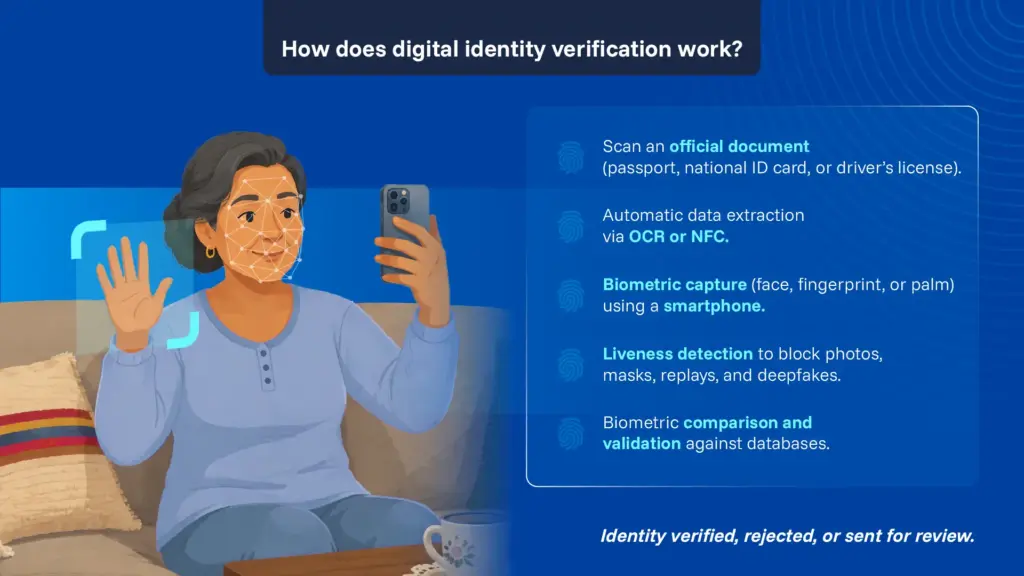
Modern digital identity verification runs entirely on a smartphone or web browser and completes in seconds. A typical flow has five steps:
- Document capture. The user photographs the front and back of a government ID. Software checks security features, fonts, MRZ codes and tamper signals.
- Data extraction. OCR and NFC (for chipped documents) extract name, date of birth and document number for downstream checks.
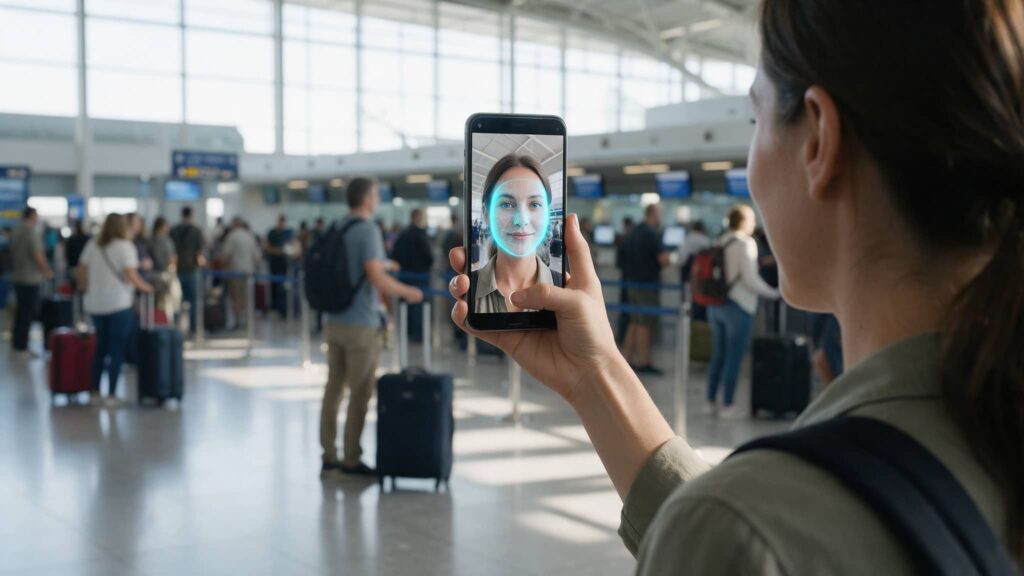
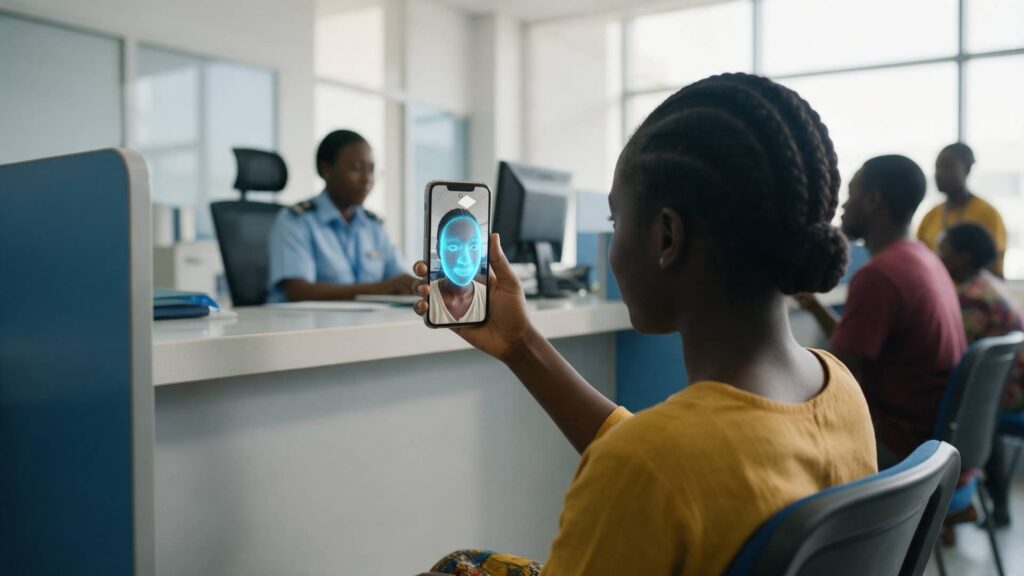
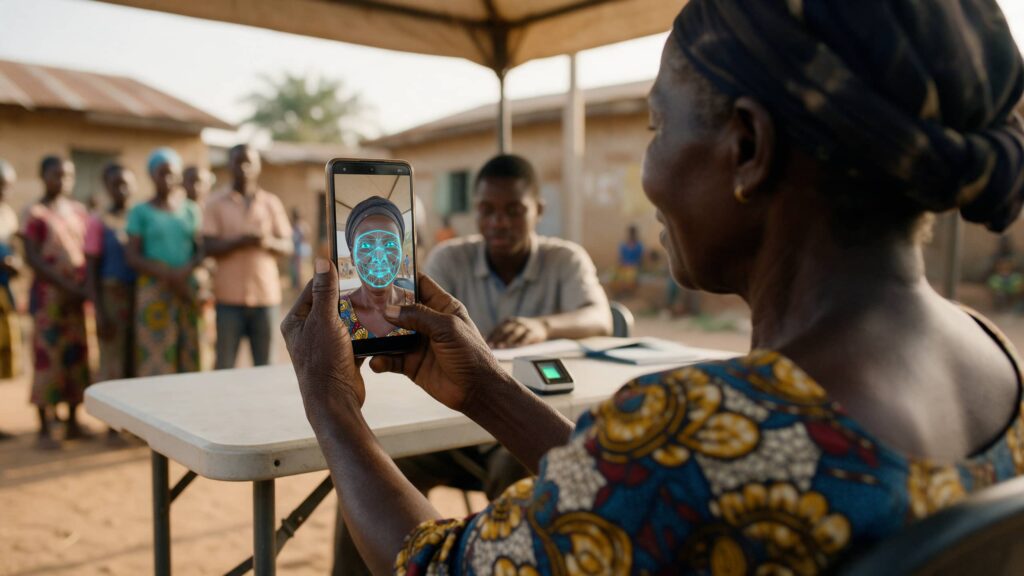
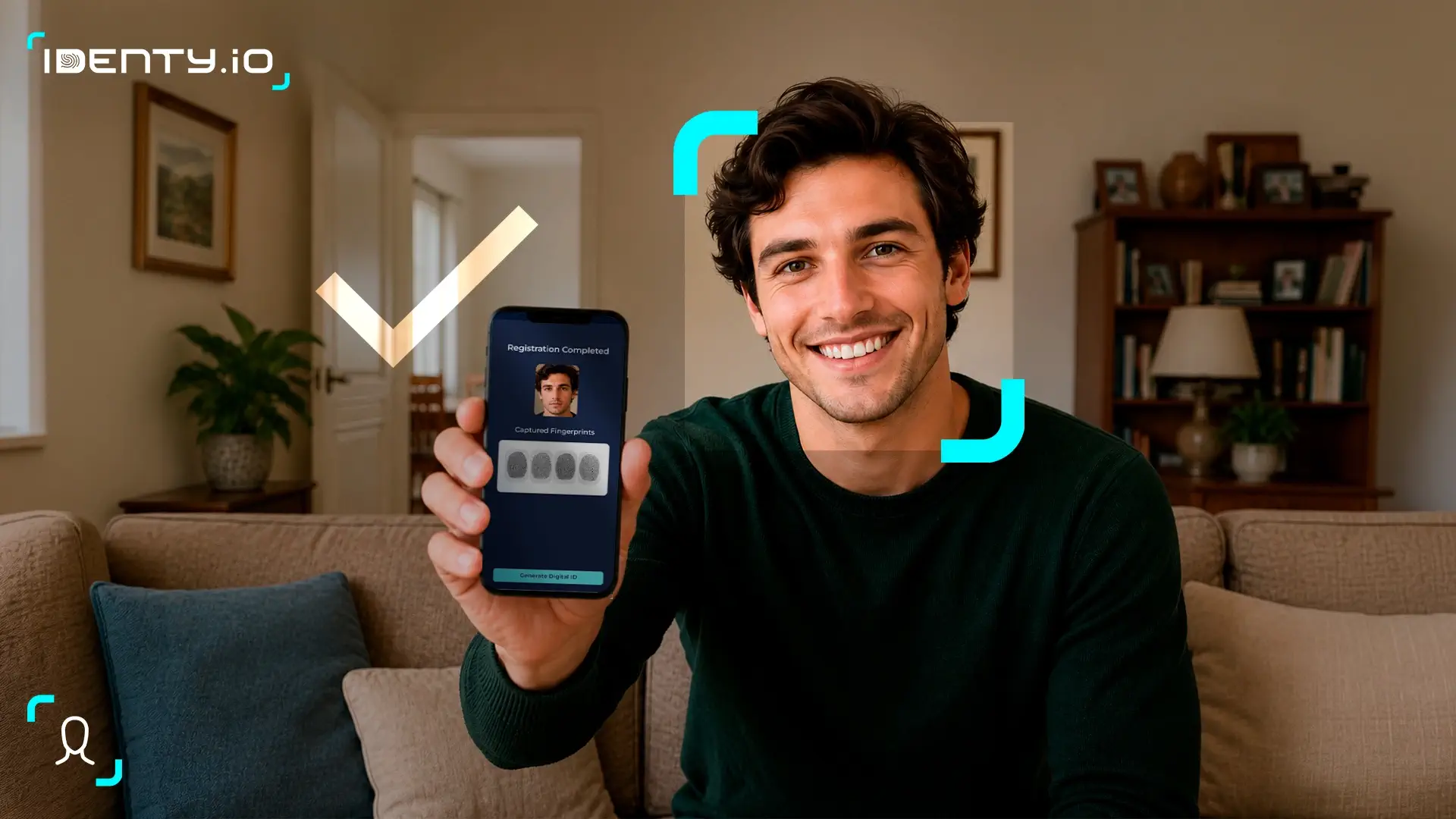
- Biometric capture. The user takes a selfie or scans a fingerprint or palm directly with the phone camera — no external hardware required with contactless biometric SDKs.
- Liveness detection. The system confirms a live human is present, blocking spoofing attempts such as printed photos, screen replays, 3D masks and injected deepfakes. See our explainer on what a liveness check is and why it matters.
- Match and decision. The live biometric is compared against the document photo; combined with database and watchlist checks, the system returns a verified / rejected / review decision.
Get a tailored demo of our contactless biometric platform and see how it fits your specific use case.
Identity Verification Methods
Document-based verification
Validates passports, national IDs and driving licences using forensic checks on security features and machine-readable zones. It is the regulatory baseline for KYC but, on its own, cannot confirm the person presenting the document is its legitimate holder.
Biometric verification
Compares a live facial image, fingerprint or palm print against the document photo or an enrolled template. Contactless fingerprint and palm capture through a standard smartphone camera extends biometric identity verification to devices without dedicated sensors, which is decisive for financial inclusion programs and government services.
Database and watchlist checks
Cross-references extracted identity data against civil registries, credit bureaus, sanctions lists and PEP databases. Strong for compliance screening; weak against synthetic identities unless paired with biometrics.
Knowledge-based and OTP methods
Security questions and SMS one-time passwords are legacy methods. Data breaches and SIM-swap fraud have degraded their reliability, which is why regulators and analysts increasingly treat them as supplementary signals rather than primary verification.
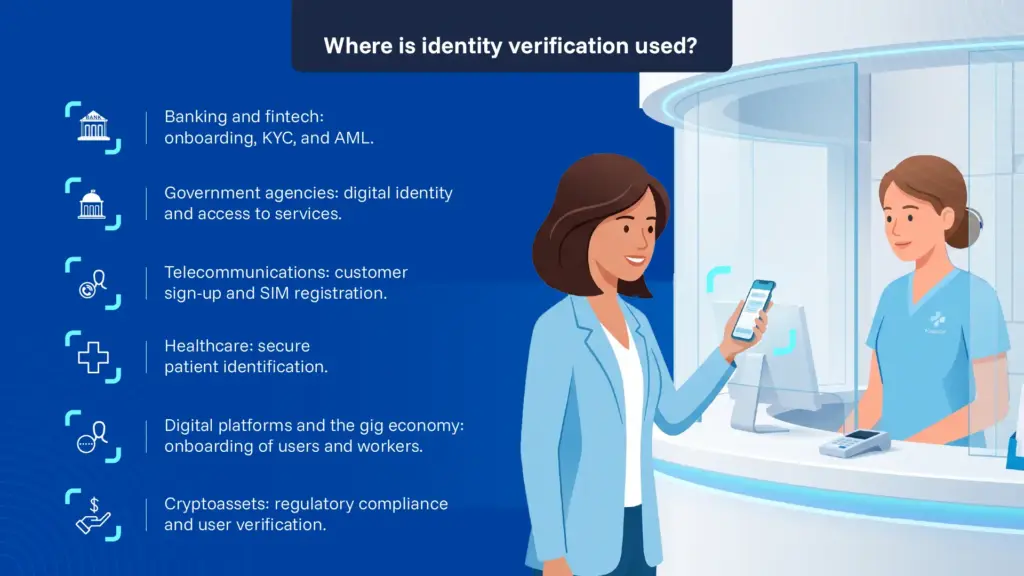
Where Identity Verification Is Required
Banking and fintech. KYC and AML regulation makes verification mandatory at onboarding. Biometric flows reduce abandonment while meeting compliance — see how face and fingerprint identification work in banking and fintech.
Government digital services. National ID programs, benefit distribution and e-government portals use biometric identity verification for government digital services to deliver services remotely without fraud leakage.
Telecommunications, healthcare, gig platforms and crypto. SIM registration mandates, patient identification, worker onboarding and travel-rule compliance all depend on fast, reliable remote verification.
Regulations Driving Identity Verification
- KYC / CDD: customer due diligence rules (e.g., FinCEN CDD Rule in the US, AMLD in the EU) require firms to verify customer identity before establishing a relationship.
- eIDAS 2.0 and the EU Digital Identity Wallet: establishes a framework for interoperable, high-assurance digital identities across the EU.
- FATF Digital Identity Guidance: endorses risk-based use of digital ID systems with certified biometrics and liveness for remote onboarding.
- ISO/IEC 30107-3: the international testing standard for presentation attack detection; certification at Level 1 and Level 2 is the de facto bar for anti-spoofing claims.
How to Choose an Identity Verification Solution
Evaluate accuracy (independent benchmarks such as NIST testing), certified liveness (ISO/IEC 30107-3), modality coverage (face, fingerprint, palm), device reach (does it work on any smartphone camera?), integration model (SDK vs API), data privacy architecture, and total cost per verification. We break down the leading vendors in our comparison of the best identity verification software.
Get a tailored demo of our contactless biometric platform and see how it fits your specific use case.
Frequently Asked Questions
What is identity verification?
Identity verification is the process of confirming that a person is who they claim to be, typically by validating a government-issued ID document, matching a live biometric sample against it, and checking the data against authoritative sources.
How does digital identity verification work?
It captures an ID document and a live biometric through a smartphone or web camera, runs liveness detection, validates the document, and matches the live sample against the document photo — remotely and in seconds.
What is the difference between identity verification and authentication?
Verification establishes who a person is the first time (account opening); authentication confirms a returning user is the same verified person.
Is biometric identity verification secure?
Yes, when combined with certified liveness detection. Solutions tested against ISO/IEC 30107-3 can reject photos, masks, replays and deepfakes, making biometrics significantly more secure than knowledge-based methods.
What industries require identity verification?
Banking and fintech (KYC/AML), government digital services, telecommunications, healthcare, gig economy platforms, crypto exchanges and online marketplaces.
Bibliography
- NIST — Face Technology Evaluations (FRTE/FRVT), National Institute of Standards and Technology. https://www.nist.gov/programs-projects/face-technology-evaluations-frtefate
- ISO/IEC 30107-3 — Information technology, Biometric presentation attack detection, Part 3: Testing and reporting. https://www.iso.org/standard/79520.html
- FATF (2020) — Guidance on Digital Identity. https://www.fatf-gafi.org/en/publications/Fatfrecommendations/Guidance-on-digital-identity.html
- European Commission — eIDAS 2.0 / European Digital Identity Wallet framework. https://digital-strategy.ec.europa.eu/en/policies/eudi-wallet
- FinCEN — Customer Due Diligence (CDD) Final Rule. https://www.fincen.gov/resources/statutes-and-regulations/cdd-final-rule