

Table of Contents
ToggleThe global retail sector is at one of the most momentous points in its history. In Mexico, this sector already contributes approximately 10% of the country’s GDP, while in Brazil, its economic weight exceeded $231.08 billion by 2025. In Colombia, the sector reached $117.48 billion last year, compared to $65 billion in Peru.
Despite this significant economic impact, the sector is facing a new paradigmatic revolution. While until only a few years ago all eyes were on the importance of launching new e-commerce models to expand the target audiences of each business, the current model focuses on greater personalisation of services to maximise user loyalty. In today’s landscape, where consumers enjoy a vast range of different products and services, competition in the retail sector is no longer just about the need for greater visibility, but above all, about fostering a smoother and more efficient shopping experience and offering increasingly rapid responses to customer expectations.
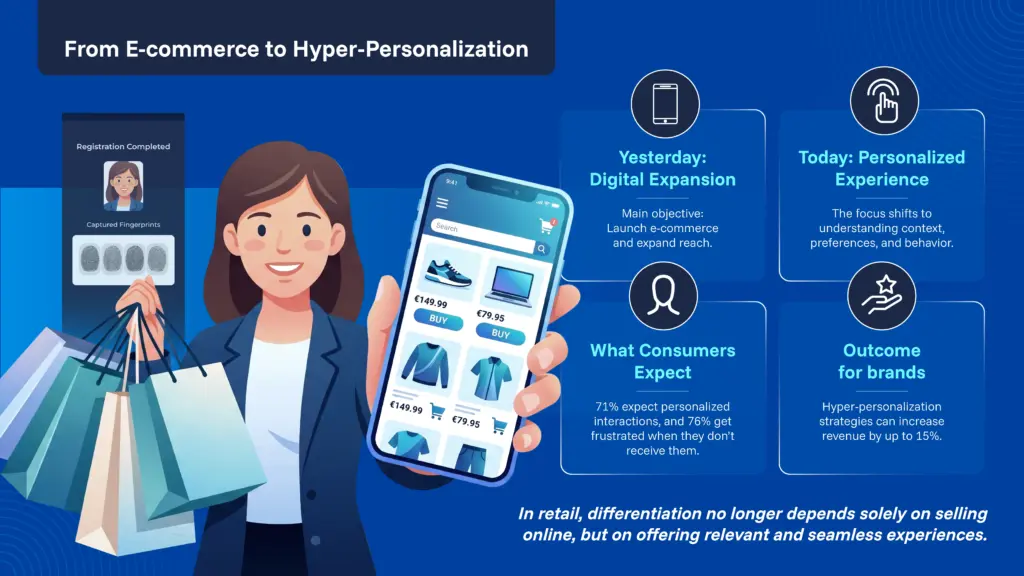
In this context, more and more companies are opting to hyper-personalise their services as a way to differentiate themselves from the competition. A report by the consultancy McKinsey mentions an increase of up to 15% in revenue for companies in the sector that use this technique, while 71% of consumers expect a more personal interaction focused on their interests, leading 76% to feel frustrated when this does not happen. Factors such as the user’s location, purchase intent, preferred channel, or the moment of interaction are becoming increasingly relevant for retail companies, allowing for the activation of relevant offers and recommendations even before the consumer starts their purchase.
Biometrics: a new ally for the retail sector
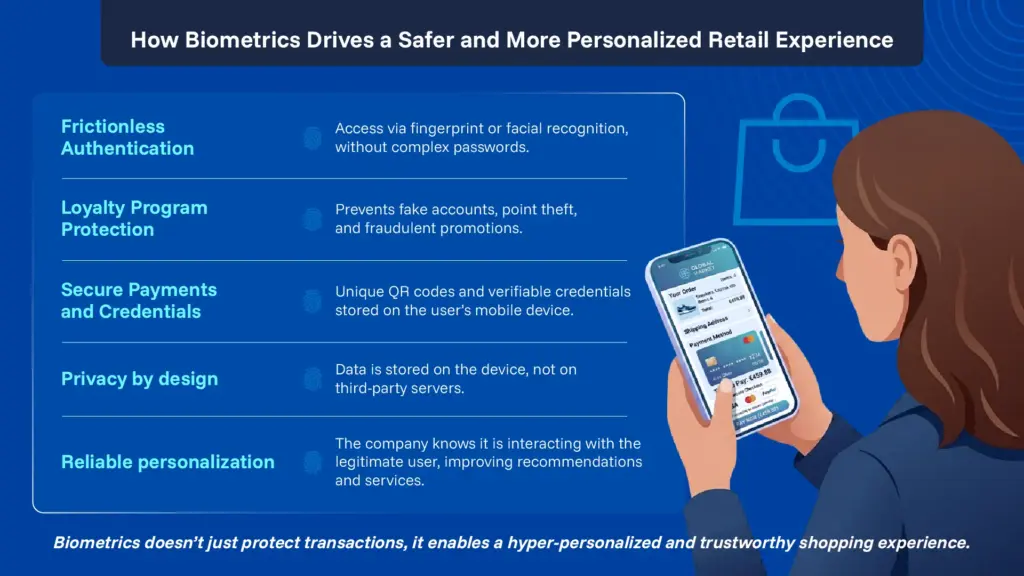
As in other sectors, these personalisation needs require the storage and use of large volumes of users’ personal information. This includes not only their habits and shopping preferences but also the transactions they have carried out or the payment methods they have used. Going further, some loyalty programmes also allow for the accumulation of points that can be redeemed for new services or physical products, sometimes of great value. This is why biometrics has established itself as a true ally for the sector, by ensuring that the user accessing certain services is truly who they say they are.
Consequently, entities like Identy.io have worked on developing new ways to manage user identity and facilitate digital transactions more securely and efficiently through biometric solutions, which allow users to manage their digital credentials to authenticate and authorise operations. In these solutions, digital credentials—the user’s personal information—are cryptographically signed and stored on their own device, allowing the user to retrieve and use them at any time, even when they do not have a reliable or stable internet connection.
Biometrics as the key to reducing digital fraud
Biometric solutions allow for the generation of a unique QR code which, acting like an electronic wallet, gathers all the information necessary to authorise payments, verify the user’s age, or interact with retail loyalty programmes. All of this is done simply and conveniently from the user’s mobile device. The user only needs to authenticate themselves in the solution using their fingerprints or facial features, without the need for passwords or complex processes. With this verified data, companies minimize the risks of forgery or identity theft, especially in situations where fraudsters might try to create fake accounts to take advantage of welcome promotions or illegitimately accumulate points. As these digital credentials are linked directly to the legal user’s identity, companies reduce the mass creation of ghost accounts or the improper redemption of points for high-value products, thus minimising losses from account takeovers.
Identy.io proposes a decentralised digital identity model based on a privacy-by-design concept. All user information is stored solely on their mobile device, without using third-party servers or clouds. All of this is done with maximum compatibility with international standards for verifiable credentials (W3C VC) and regulatory frameworks such as eIDAS 2.0 in Europe or the progress of CUID in Mexico. Users can choose at any time what personal information they share, when, and with whom, in the most secure way thanks to passive liveness detection with AI algorithms, which prevents fraud, identity theft, and credential forgery.
As we can see, incorporating biometrics into the retail user experience goes beyond the use of a simple conventional wallet. By enabling secure payments, access to discounts, rewards, or participation in loyalty programmes, this technology becomes a strategic solution for the sector. At a time when user experience is becoming one of the pillars underpinning the industry’s growth, the ability to offer secure transactions, privacy, and hyper-personalised shopping experiences is key to generating value for both users and companies in the sector.