

Table of Contents
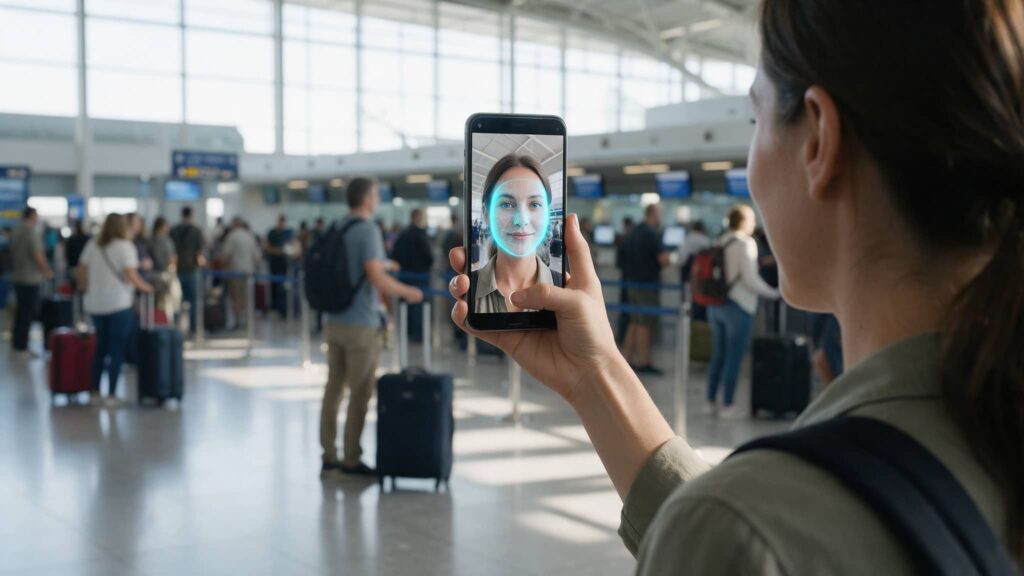
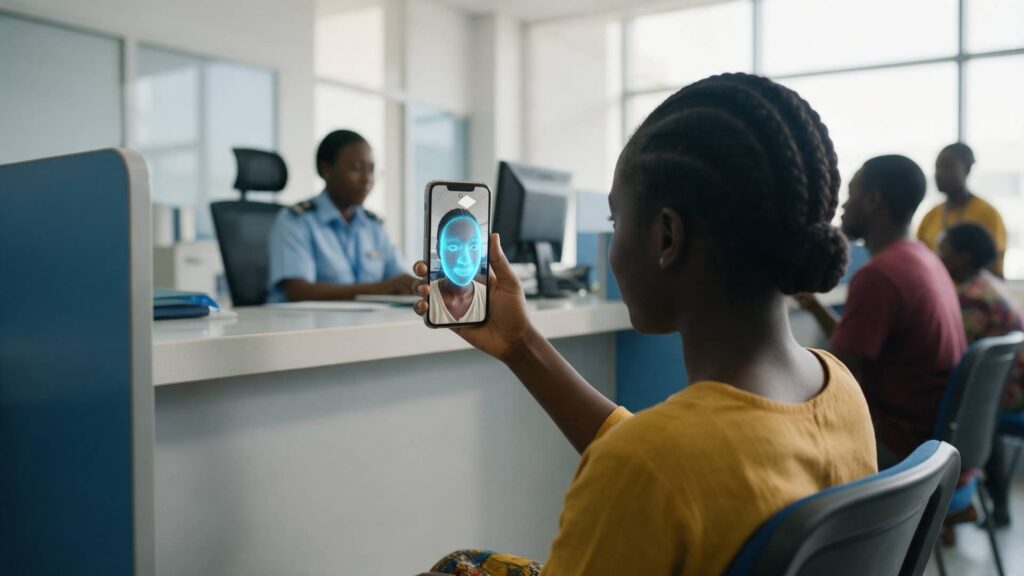
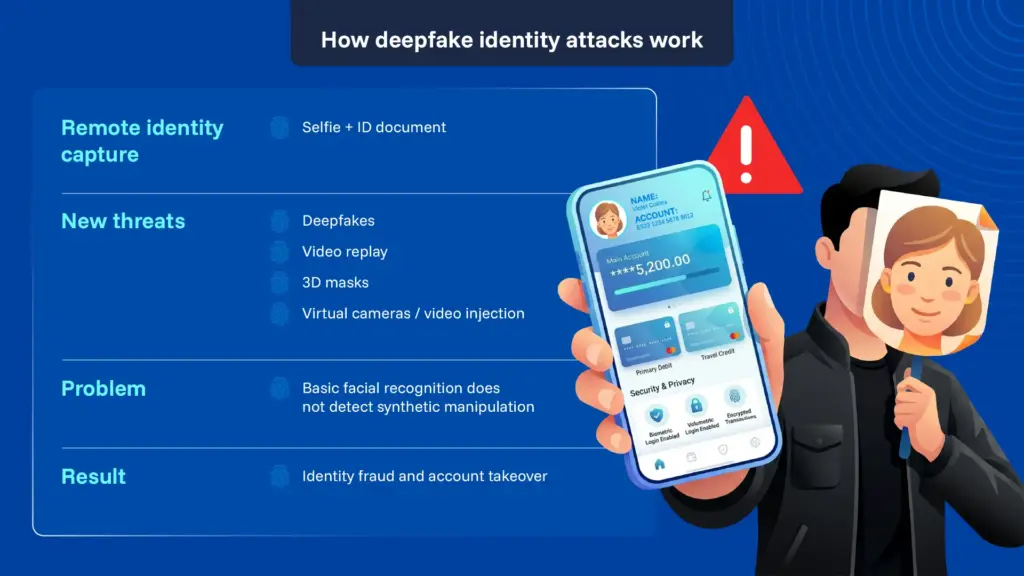
ToggleRemote identity proofing now relies on document capture, selfie verification, and automated face comparison at scale. Traditional KYC and basic face matching were built to confirm likeness and document evidence, not to prove that a camera stream is genuine or that submitted media has not been synthetically altered. NIST now warns that remote proofing is vulnerable to digital injection and forged media, and explicitly notes that biometric comparison alone does not prevent these attacks. At the same time, UK government research points to growing demand for deepfake controls in identity fraud, account takeover, and synthetic identity fraud across financial services. That is why an identity verification anti-deepfake solution has moved from security feature to operating requirement.
Deepfakes are becoming more sophisticated, increasing the risk of fraud and identity manipulation in digital environments. Download our 10-step guide to learn how to detect threats early and protect your organization with proven best practices.
How modern attacks break weak onboarding stacks
ENISA identifies photo attacks, video replay, 3D masks, and deepfake attacks as major risks in remote identity proofing. NIST materials on injection methods add another uncomfortable truth: attackers can use virtual cameras, device emulators, function hooking, or man-in-the-middle replacement of the camera feed so the verifier receives manipulated media that appears to come from a real sensor. Once that happens, identity spoofing becomes scalable. The attack no longer targets only the matcher; it targets the media pipeline itself.
What separates a robust anti-deepfake solution
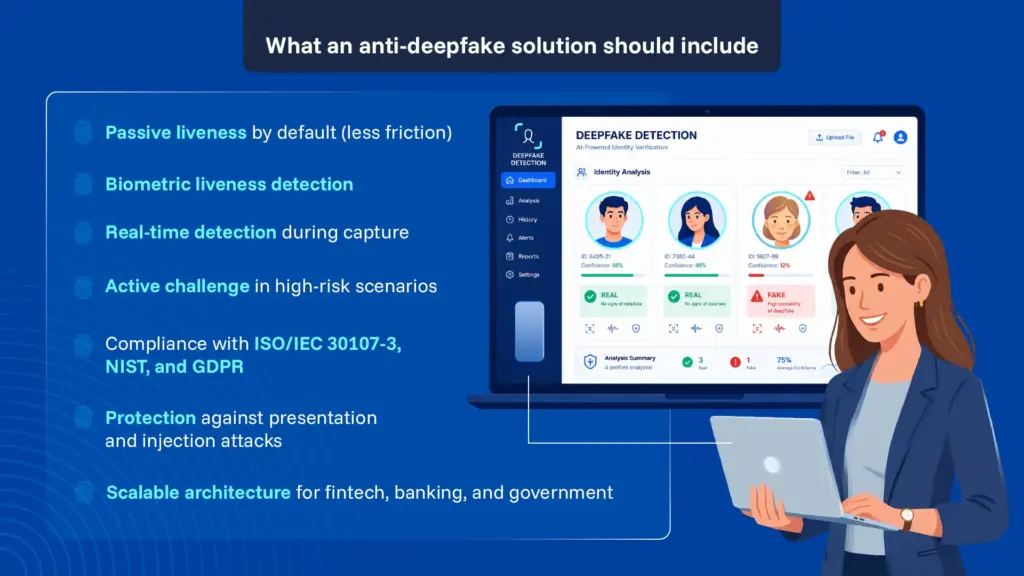
A credible solution combines deepfake detection for identity verification with biometric liveness detection, presentation attack detection aligned with ISO/IEC 30107-3, and explicit resistance to injection attacks. Under the ISO PAD framework, the meaningful questions are whether attack presentations are wrongly accepted and bona fide users are wrongly rejected, rather than whether a vendor claims “high AI accuracy.” In practice, face liveness detection software should be independently tested, operate during the proofing session, and resist both presentation attacks in front of the camera and digitally injected media behind it. NIST’s latest guidance also expects controls that raise confidence the media is coming from a genuine sensor, including checks for virtual cameras, emulators, and jailbroken devices.
Get a tailored demo of our contactless biometric platform and see how it fits your specific use case.
Passive assurance, active challenge when risk is higher
ENISA distinguishes passive and active liveness. Passive controls require no user action and analyze involuntary cues or deepfake artefacts, while active controls introduce randomized movements or interactions to make replay and low-complexity spoofing harder. For conversion-sensitive fintech onboarding, that trade-off matters. Passive checks are usually the better default because they reduce friction.
Architecture and privacy decide whether security scales
Detection quality is only half the decision. High-volume onboarding flows also need low latency, predictable operating cost, and a privacy model that can withstand regulatory review. Official UK guidance states that biometric data used to uniquely identify someone is special category data, which means organizations need a lawful basis, a specific condition for processing, and heightened safeguards. The European Data Protection Board also stresses that privacy by design is mandatory and has said that biometric storage models are most defensible when the data stays in the hands of the individual, or when only the individual controls the key. That makes on-device processing strategically attractive: it can reduce server dependency, limit data exposure, and lower infrastructure costs at the same time.
The strategic takeaway for fintech, banking, and government
An identity verification anti-deepfake solution is no longer defined only by detection accuracy. The real differentiator lies in how effectively it integrates security, scalability, and user experience into a single operational model.
This is where platforms like Identy.io illustrate the direction the industry is moving toward.
By combining AI-based identity verification security with on-device biometric processing, Identy addresses several structural challenges in modern identity systems:
- Reduced attack surface: Processing biometric data directly on the user’s device minimizes exposure to injection attacks, server breaches, and man-in-the-middle manipulation.
- Real-time deepfake and liveness detection: Integrated biometric liveness detection and face liveness detection software operate during the capture process, enabling immediate detection of presentation and injection attacks without relying on post-processing.
- Lower latency and higher conversion: Eliminating server-side dependencies reduces delays in onboarding flows, directly impacting user completion rates in fintech and digital services.
- Scalable infrastructure: A serverless architecture removes the need for heavy backend processing, allowing organizations to scale identity verification without proportional increases in infrastructure cost.
- Privacy-by-design compliance: Keeping biometric data on-device aligns with GDPR principles and reduces regulatory exposure, particularly when handling sensitive biometric identifiers.
Aligned with standards such as ISO/IEC 30107-3, NIST Digital Identity Guidelines, and FIDO frameworks, this approach reflects a broader shift: identity verification systems must now secure not only the identity itself, but the integrity of the entire capture and processing pipeline.
For decision-makers, the implication is clear. The question is no longer whether to implement deepfake detection for identity verification, but how to deploy it in a way that preserves user experience, ensures compliance, and scales sustainably.
Get a tailored demo of our contactless biometric platform and see how it fits your specific use case.
Bibliography
- NIST – https://www.nist.gov
- ENISA – https://www.enisa.europa.eu
- European Data Protection Board – https://www.edpb.europa.eu
- ICO – https://ico.org.uk
- FIDO Alliance – https://fidoalliance.org