
Table of Contents
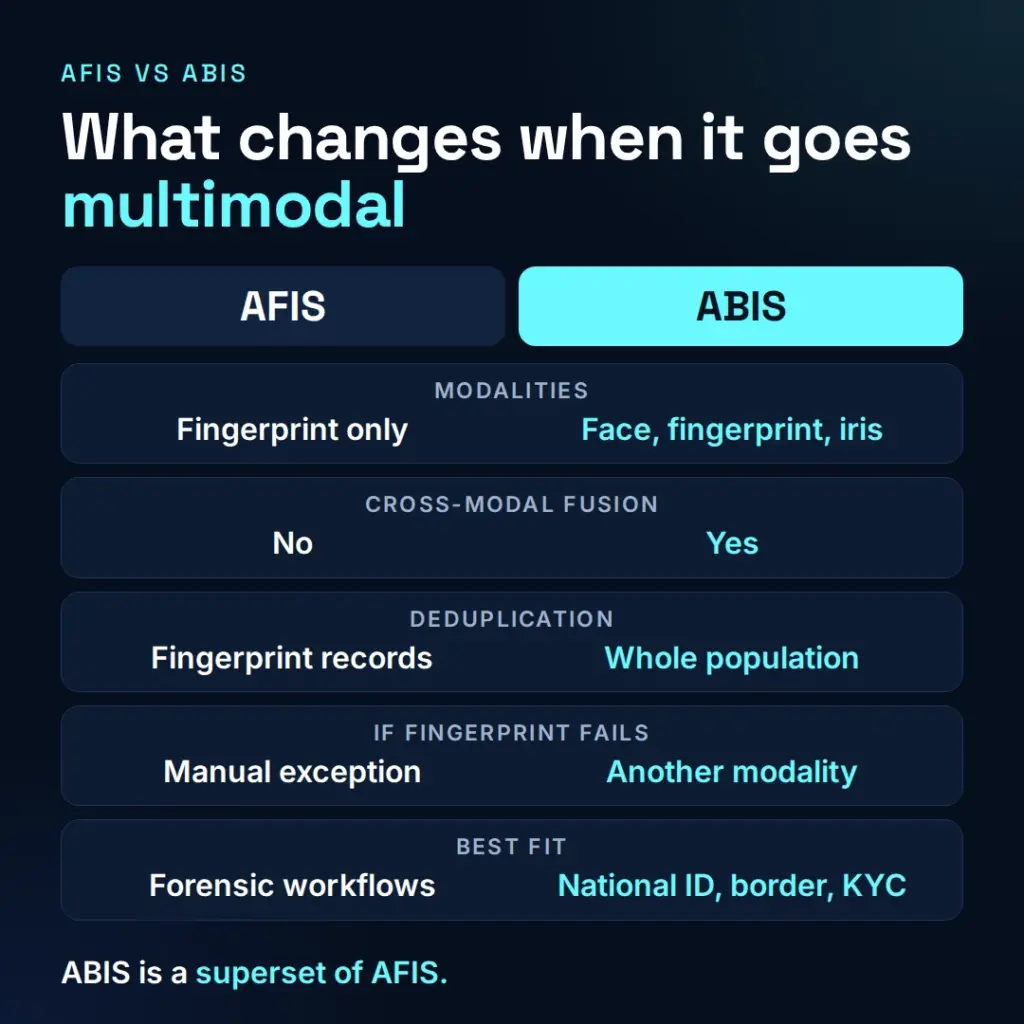
ToggleThe honest version of this comparison is that ABIS is a superset of AFIS. An AFIS searches fingerprints, and often palmprints. An ABIS adds faces and, in some deployments, irises, and it can combine them. Everything else follows from that.
What that superset buys you, and what it costs, is worth going through properly, because the decision is rarely about algorithm accuracy and almost always about what happens to the people your system cannot read.
The short answer
| AFIS | ABIS | |
|---|---|---|
| Modalities | AFISFingerprint, often palmprint | ABISFace, fingerprint, often iris and palm |
| Fusion across modalities | AFISNo | ABISYes |
| Deduplication scope | AFISFull population, friction ridge records only | ABISFull population, any modality |
| Fallback when a modality fails | AFISManual process | ABISAnother modality |
| Typical capture | AFISDedicated scanner, operator present | ABISScanner or mobile device, supervised or unsupervised |
| Standards footprint | AFISISO/IEC 19794-2 (finger minutiae), ISO/IEC 19794-4 (finger and palm images), ANSI/NIST-ITL | ABISAdds ISO/IEC 19794-5 (face images), ISO/IEC 19794-6 (iris images), ISO/IEC 30107 (PAD) and ISO/IEC 39794 |
| Best fit | AFISForensic and criminal investigations | ABISNational ID, civil registry, border, onboarding |
Deepfakes are becoming more sophisticated, increasing the risk of fraud and identity manipulation in digital environments. Download our 10-step guide to learn how to detect threats early and protect your organization with proven best practices.
Where the difference actually bites: exception handling
Every large biometric programme has a failure to enrol rate. Manual labour wears down ridge detail. Age flattens it. Skin conditions and certain occupations make fingerprint capture unreliable for a measurable slice of any real population.
In a fingerprint-only system, those people become an exception queue. They are processed manually, which is slow, expensive and inconsistent, and in national programmes it is the group least able to absorb friction.
In a multimodal system, they are not an exception. If the fingerprint is unusable, the face carries the transaction. That is not a feature comparison, it is the difference between a programme that covers a population and a programme that covers most of it.
Fusion is not the same as having two modalities
A system can hold face and fingerprint records and still treat them as two separate databases. Fusion means the matcher combines evidence from both to reach a single decision.
This matters as the gallery grows. In a 1:N search, the probability of a false positive rises with N. Fusing two independent biometric characteristics tightens the result without forcing you to raise the threshold so far that genuine subjects start getting rejected. NIST evaluates 1:N performance for face and for fingerprint separately, through FRTE 1:N and FRIF TE E1N respectively, and the published results give you a baseline for each modality before fusion enters the picture.
Deduplication is the operation people underestimate
Verification asks whether this person is who they claim to be. Deduplication asks whether this person is already in the database under a different name. The second question is the one that protects a national registry, a benefit programme or a voter roll from duplicate identities.
Deduplication is a 1:N search run at enrolment, against the entire population, every time. An AFIS can already do this across its fingerprint and palm records. A multimodal system runs it on face and fingerprint together, which catches duplicates that a single modality would miss, for example someone enrolling twice with deliberately degraded fingerprints.
Identy.io’s ABIS handles enrolment processing, encrypted template storage, searchable index generation and a deduplication engine with configurable tolerance margins, and was validated through MOSIP’s partner compliance process for governments deploying on that platform.
The part most comparisons skip: capture
Classic AFIS design assumes a controlled capture point. A dedicated scanner, an operator, a physical location. Under that assumption, capture security is a property of the room.
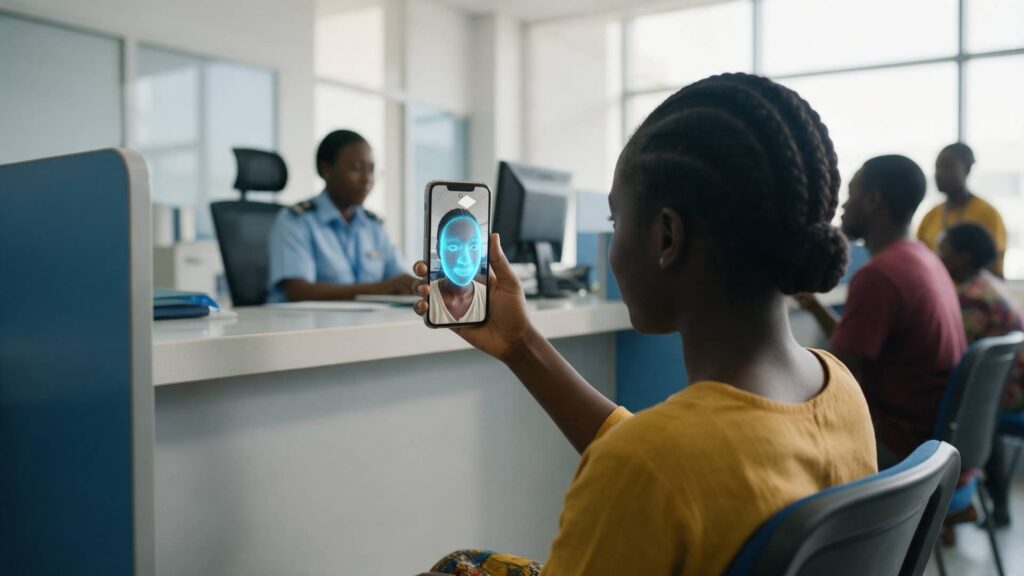
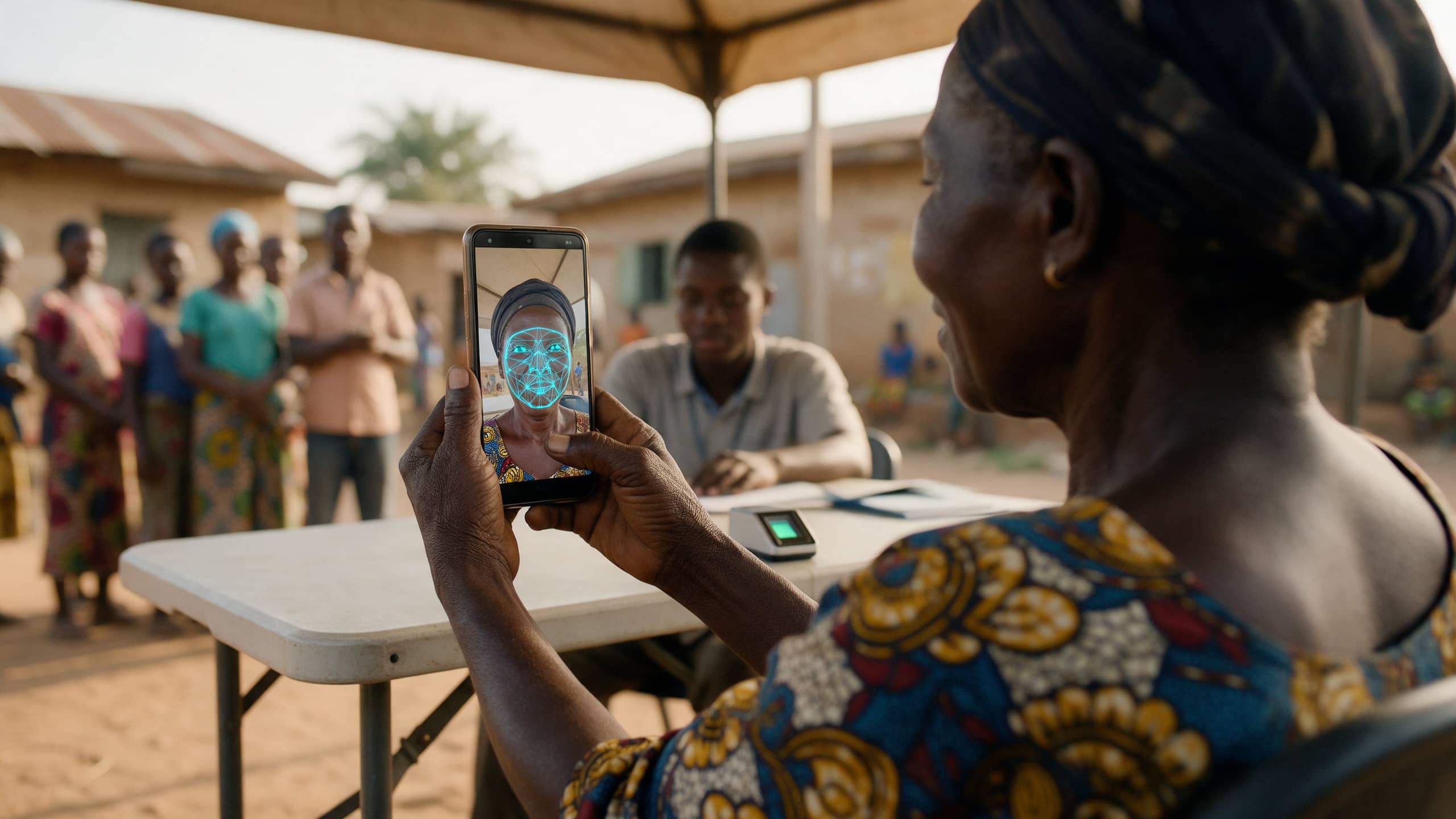
Modern enrolment does not work that way. Registration happens in the field, on a phone, sometimes unsupervised. Once that is true, two new questions appear that an AFIS was never designed to answer.
Is the biometric coming from a live person? This is presentation attack detection, defined and measured by ISO/IEC 30107-3. Identy.io’s facial biometric technology has been independently certified to ISO/IEC 30107-3 Level 1 and Level 2 by iBeta with a 0 percent Imposter Attack Presentation Match Rate under the conditions of that test.
Is the biometric entering through the sensor at all? Injection attacks bypass the camera entirely and feed a synthetic stream into the application. No matching engine, however accurate, can detect this, because by the time the template reaches the matcher it looks legitimate. The defence has to sit at the capture layer.
This is why Identy.io processes biometric capture on the device itself. The image is validated where it is created, before it travels anywhere.
Where an AFIS is still the right answer
If your workflow is forensic, latent-print driven, and tied to an existing criminal justice infrastructure with established interoperability requirements, a specialised AFIS is a reasonable choice. Latent matching is a distinct discipline with its own evaluation track, and a general purpose multimodal system is not automatically better at it.
The same applies if your population is small, your capture environment is controlled and you have no deduplication requirement. Added modalities you do not use are added cost and added governance burden.
How migrations usually go
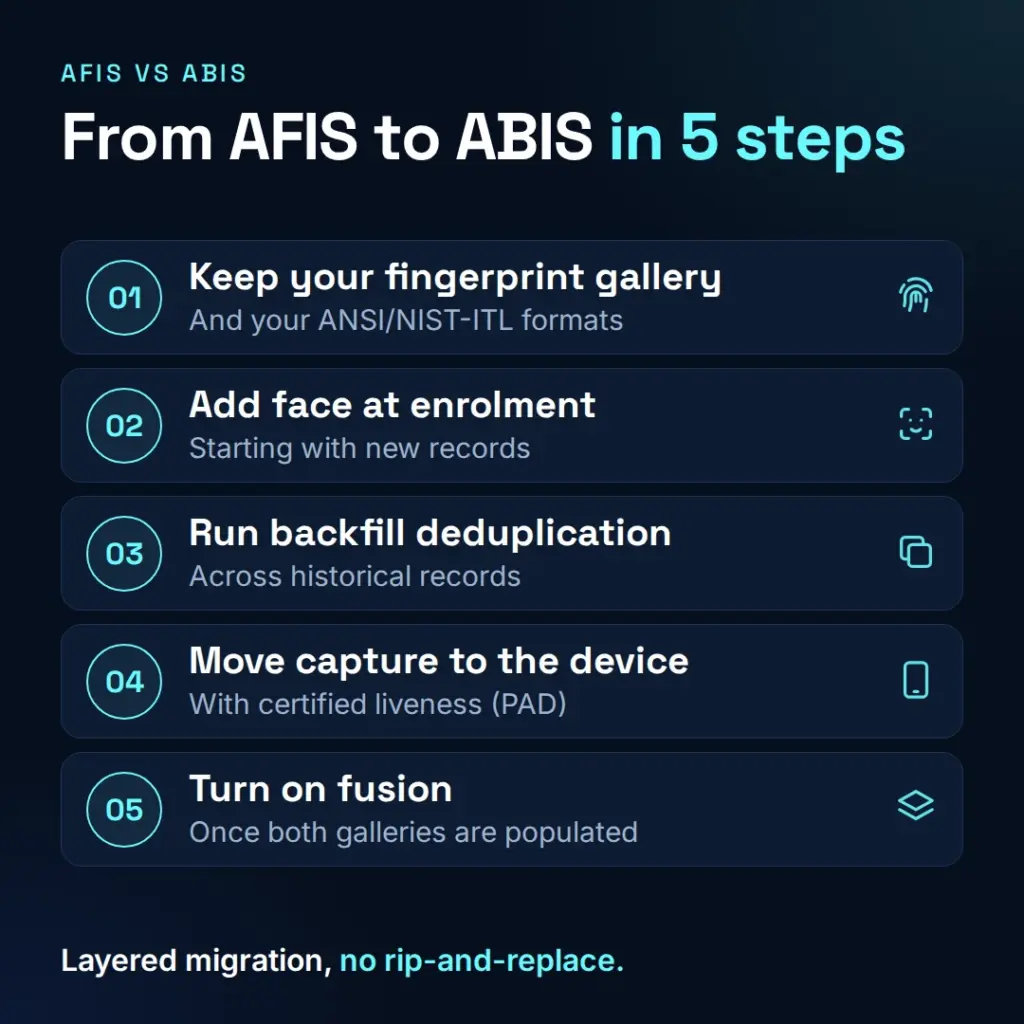
Programmes rarely rip out an AFIS. The common path is layered.
- Keep the existing fingerprint gallery and the ANSI/NIST-ITL interchange formats already in use.
- Add a face modality at enrolment, starting with new records.
- Run backfill deduplication on the historical population, usually the step that surfaces the most value and the most surprises.
- Move capture to a device-based flow with certified presentation attack detection.
- Introduce fusion at the matching layer once both galleries are populated.
Ask any vendor to describe their support for each of those five steps specifically. A datasheet that lists modalities tells you nothing about migration.
Frequently asked questions
What is the difference between AFIS and ABIS?
An AFIS is an Automated Fingerprint Identification System and searches friction ridge data: fingerprints and often palmprints. An ABIS is an Automated Biometric Identification System and handles multiple modalities, typically face and fingerprint and sometimes iris, and can fuse evidence across them. ABIS is effectively a superset of AFIS: it keeps the same search engine logic and adds modalities, cross-modal fusion and deduplication across all of them.
Is ABIS better than AFIS?
For national identity programmes, civil registries, border control and digital onboarding, an ABIS is generally the better fit because it handles subjects whose fingerprints cannot be captured reliably and deduplicates across every modality. For forensic workflows built around latent prints and existing criminal justice interoperability, a specialised AFIS can remain the right choice. The deciding factor is usually exception handling, not headline accuracy.
Can an ABIS replace an existing AFIS without losing data?
Yes, when the ABIS supports the interchange formats already in use, such as ANSI/NIST-ITL and the ISO/IEC 19794 and ISO/IEC 39794 series. Most programmes migrate in layers: keep the fingerprint gallery, add a face modality for new enrolments, run backfill deduplication on historical records, move capture to a device-based flow, and enable fusion once both galleries are populated.
What is biometric deduplication?
Deduplication is a one-to-many search run at enrolment that checks whether a person is already registered in the database under a different identity. It is what prevents duplicate records in national registries, benefit programmes and voter rolls. An AFIS deduplicates on fingerprint and palm records; a multimodal system can deduplicate on face and fingerprint together, catching duplicates that a single modality would miss.
Does an ABIS protect against injection attacks?
Not on its own. An injection attack bypasses the camera and feeds a synthetic stream directly into the application, so the template reaching the matching engine looks legitimate. The defence has to sit at the capture layer, through presentation attack detection tested against ISO/IEC 30107-3 and through processing the capture on the device where it is created.
References
- NIST. Glossary: Automated Biometric Identification System (IDENT). https://www.nist.gov/glossary-term/18926
- NIST. Face Recognition Technology Evaluation (FRTE) 1:N Identification. https://pages.nist.gov/frvt/html/frvt1N.html
- NIST. FRIF TE E1N: Fingerprint 1:N Identification Results. https://fingerprint.nist.gov/frifte/e1n/results/
- ISO/IEC 19794-2. Biometric data interchange formats — Part 2: Finger minutiae data.
- ISO/IEC 19794-4. Biometric data interchange formats — Part 4: Finger image data.
- ISO/IEC 19794-5. Biometric data interchange formats — Part 5: Face image data.
- ISO/IEC 19794-6. Biometric data interchange formats — Part 6: Iris image data.
- ISO/IEC 30107-3:2023. Biometric presentation attack detection — Part 3: Testing and reporting. https://www.iso.org/standard/79520.html
- iBeta Quality Assurance. ISO 30107-3 Presentation Attack Detection Test Methodology. https://www.ibeta.com/iso-30107-3-presentation-attack-detection-confirmation-letters/
- ISO/IEC 2382-37:2022. Information technology — Vocabulary — Part 37: Biometrics. https://www.iso.org/standard/73514.html
- MOSIP Marketplace. Identy.io ABIS product listing. https://marketplace.mosip.io/products/305
- Biometric Update. Identy places ABIS in MOSIP marketplace following certification, 2025. https://www.biometricupdate.com/202511/identy-places-abis-in-mosip-marketplace-following-certification
- Department of Homeland Security. Biometrics. https://www.dhs.gov/biometrics