
Table of Contents
ToggleWhether an AFIS identifies anyone depends on how it is deployed. In a criminal investigation it returns a ranked list of candidates and a trained examiner decides. In a civil identification programme it applies a score threshold and can reach the decision on its own. That distinction explains most of what follows, and it is the first thing to understand before comparing systems.
AFIS stands for Automated Fingerprint Identification System. It is a search engine for fingerprints. You submit a print, the system compares it against millions of stored records, and it returns the most similar ones. Law enforcement agencies, border authorities and civil registries have relied on this architecture for more than twenty-five years.
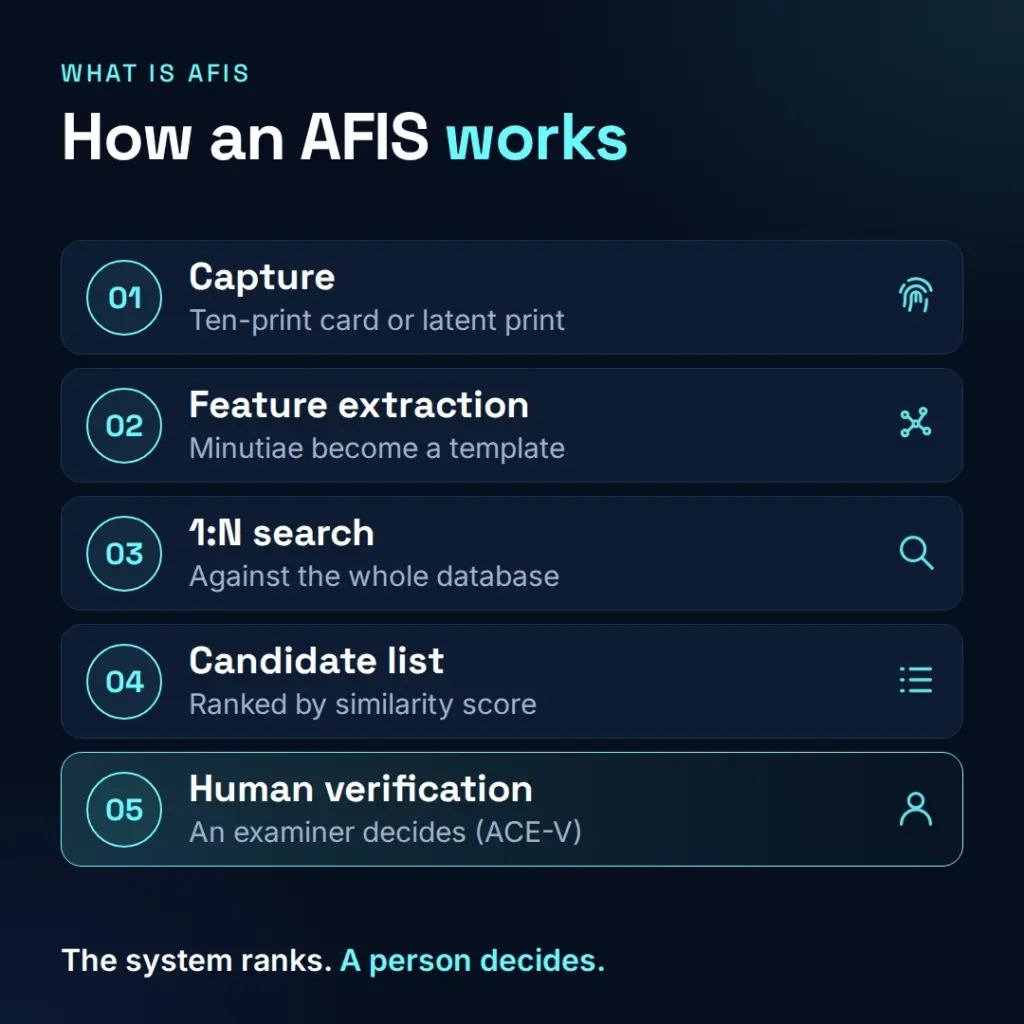
How an AFIS works, step by step
Capture. A fingerprint enters the system either as a ten-print card, scanned live or digitised from ink, or as a latent print lifted from a surface. Capture quality sets the ceiling for everything that follows. A poor image cannot be rescued by a better matcher.
Feature extraction. The system does not store or compare pictures of fingers. It extracts minutiae, the points where ridges end or split, and encodes their position, direction and relationship to each other. The result is a template. The standard formats for these templates are defined in ISO/IEC 19794-2 and the newer ISO/IEC 39794 series.
Search. The query template is compared against the enrolled gallery. This is a one-to-many operation, usually written as 1:N, where N is the number of records in the database.
Scoring. Every comparison produces a similarity score. The score is not a probability that two prints came from the same finger. What the system does with it depends on the operating mode.
Decision. Here the two modes split.
- Investigation mode, typical of criminal casework. The system returns a ranked candidate list and a latent print examiner reviews it using the ACE-V methodology, which stands for Analysis, Comparison, Evaluation and Verification. The conclusion belongs to the examiner, not to the algorithm.
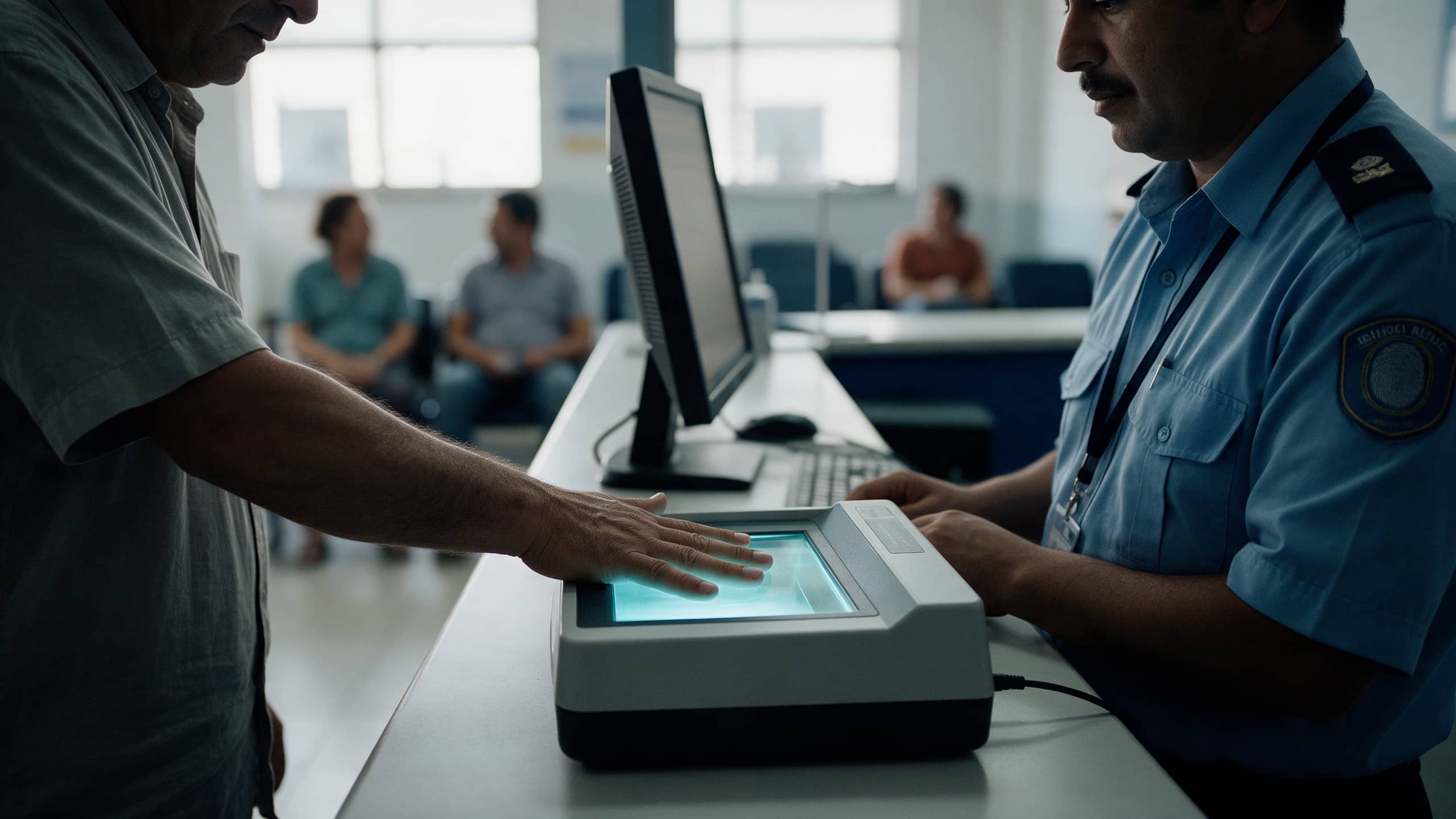
- Identification mode, typical of civil programmes such as national ID, voter registration or benefits. The system applies a threshold and only returns candidates whose score exceeds it. A hit can be accepted automatically, or confirmed by a trained operator where the programme requires it. No forensic examiner is involved, which is what allows these systems to process millions of transactions.
Deepfakes are becoming more sophisticated, increasing the risk of fraud and identity manipulation in digital environments. Download our 10-step guide to learn how to detect threats early and protect your organization with proven best practices.
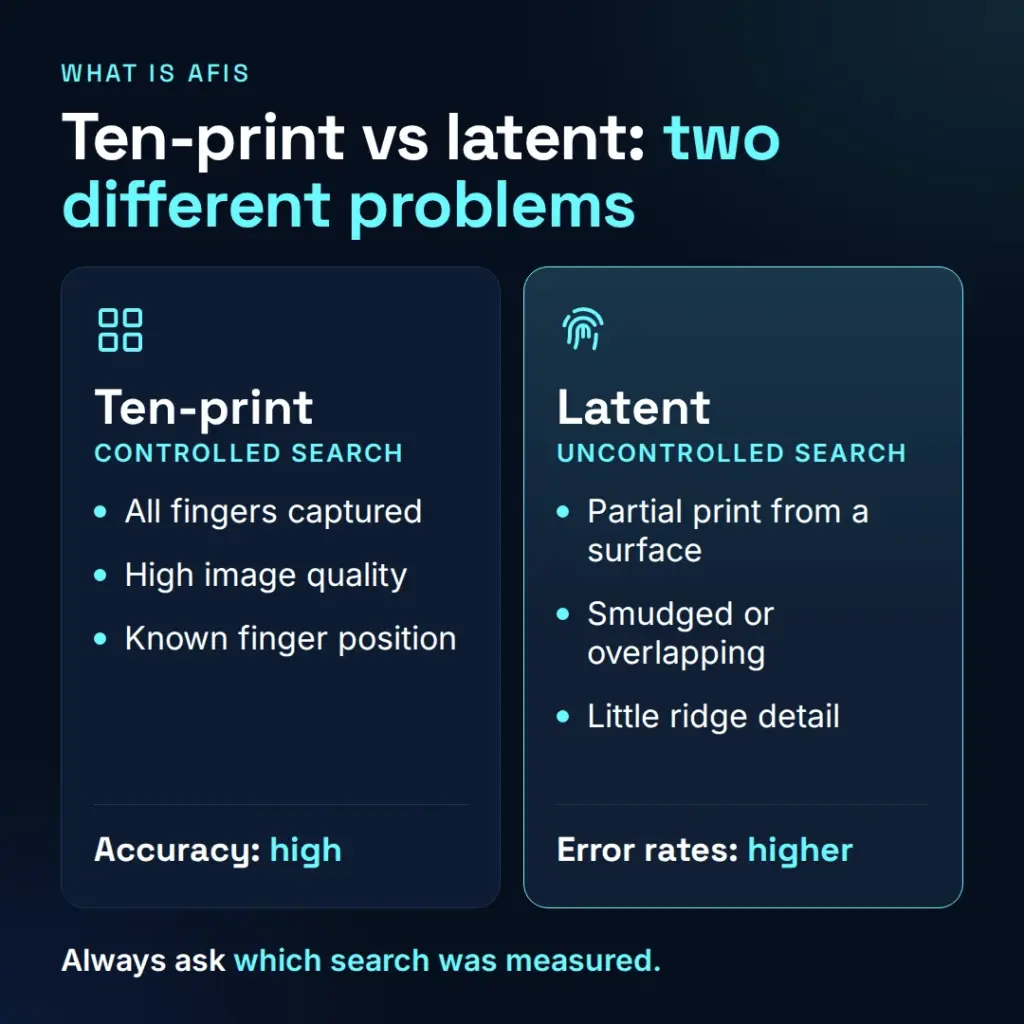
Ten-print searches and latent searches are different problems
A ten-print search compares a complete, controlled set of prints against the gallery. Image quality is high, the finger position is known, and accuracy is correspondingly high. This is the workload behind almost every civil programme, from enrolment deduplication to identity checks at a border.
A latent search starts from a partial print, often smudged, distorted or overlapping with other marks. The system may have a fraction of the ridge detail available.
NIST evaluates the two separately. The FRIF TE Exemplar One-to-Many evaluation, known as FRIF TE E1N, tests how algorithms extract features from exemplar prints (rolled, slaps and palms) and search them against galleries of millions of subjects. It relaunches the earlier Fingerprint Vendor Technology Evaluation, FpVTE. Latent matching has its own track, the Evaluation of Latent Friction Ridge Technology, because the error profile is so different.
Any conversation about AFIS accuracy that does not specify which of the two operations is being measured is incomplete.
Where AFIS systems are deployed
The FBI operated the Integrated Automated Fingerprint Identification System from July 1999. It was replaced by Next Generation Identification, which the FBI describes as the world’s largest electronic repository of biometric and criminal history information. By 2024 the Bureau reported more than 161 million fingerprint records in the system, with 97 percent of incoming fingerprints processed automatically.
Beyond law enforcement, the same architecture appears in national identity programmes, voter registration, social benefit distribution, border control and financial onboarding in markets where fingerprint is the dominant modality. These are identification-mode deployments, where the threshold and the automatic decision matter more than the candidate list.
What AFIS does well, and where it stops
AFIS technology is mature, well understood and heavily benchmarked. The reference benchmark for large-scale identification is NIST FRIF TE E1N, an open-set 1:N evaluation that exercises the template creation and search algorithms at the core of an identification system. It is the closest public measure of how an engine will perform in a real national-scale deployment. NIST also runs MINEX III for interoperable template matching and PFT III for proprietary one-to-one matching. Vendors submit algorithms and results are published.
Three limits are structural rather than a question of algorithm quality.
One modality. An AFIS works with fingerprints. If the fingerprint is unusable, and manual labour, age or skin condition make that common in real populations, the system has no second route to a decision.
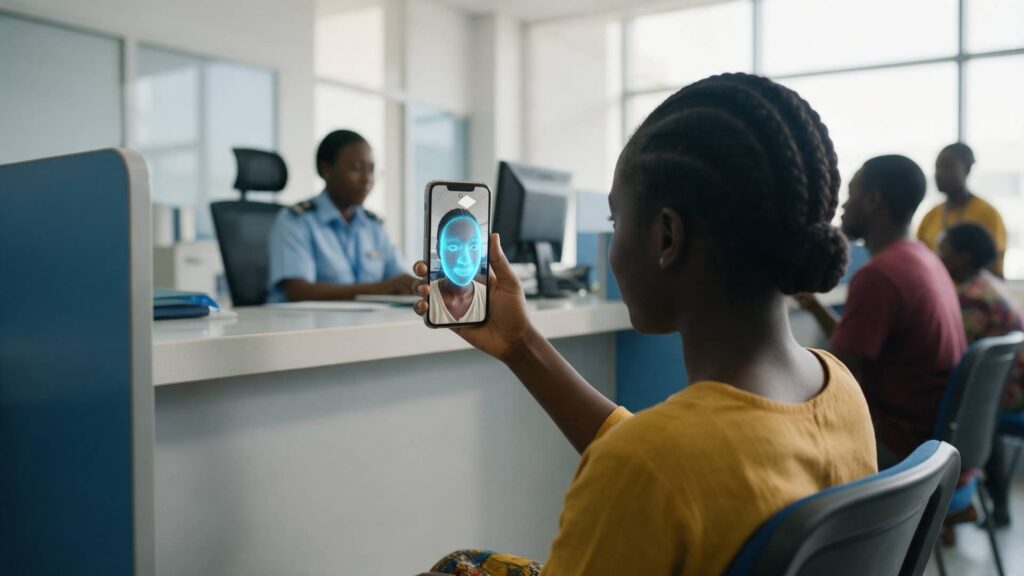
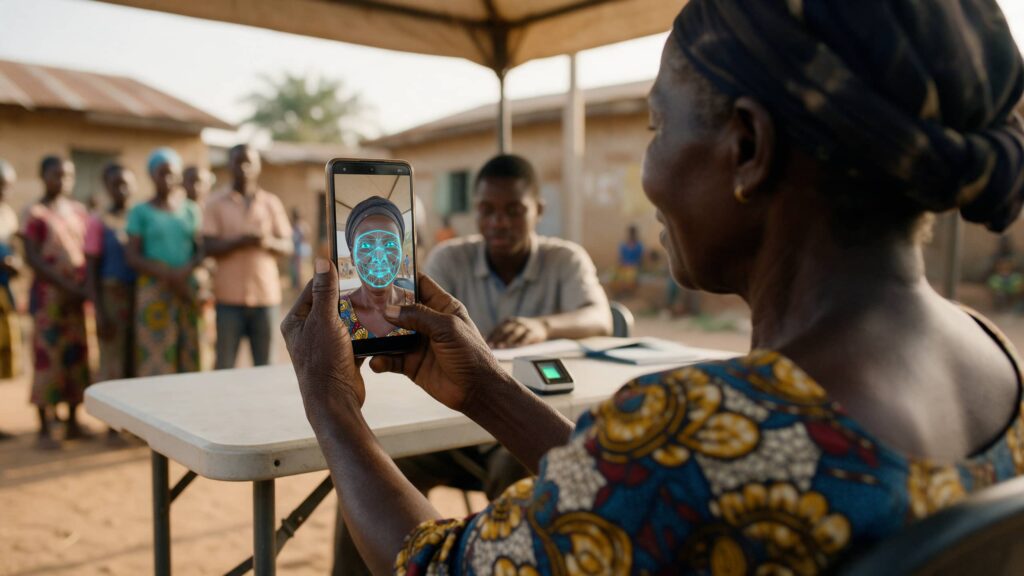
Capture is assumed, not protected. Classic AFIS design assumes a controlled capture environment with a dedicated scanner and an operator present. That assumption does not hold when enrolment happens through a mobile phone in the field.
Centralised by default. Every search travels to a central matcher. In low connectivity environments, or during an outage, the operation stops.
What replaced AFIS
The answer in most modern programmes is ABIS, an Automated Biometric Identification System. An ABIS keeps the search engine logic of AFIS and extends it to several modalities, typically face and fingerprint, and in some deployments iris. NIST uses the term in its own glossary to describe the Department of Homeland Security IDENT system.
The practical difference is not the number of modalities on a datasheet. It is that a multimodal system can fuse evidence from more than one biometric characteristic, deduplicate an entire population at enrolment, and keep working when one modality fails for a given subject.
Identy.io approaches this from the capture end as well as the matching end, with on-device processing so that the biometric is validated on the phone before anything reaches the central system. That combination of edge capture and central 1:N matching is where most large programmes are landing today.
Frequently asked questions
What does AFIS stand for?
AFIS stands for Automated Fingerprint Identification System. It is a database and search engine that compares a submitted fingerprint against millions of enrolled records and returns the most similar ones, either as a ranked candidate list or as a hit above a score threshold.How does an AFIS work?
An AFIS captures a fingerprint, extracts minutiae such as ridge endings and bifurcations into a template, and searches that template against the enrolled gallery in a one-to-many operation. In criminal investigation it returns a ranked candidate list that a latent print examiner verifies using ACE-V. In civil identification it applies a score threshold and only returns candidates above it, so the system can decide automatically or a trained operator can confirm the hit.Does an AFIS always need a human examiner?
No. Forensic examiners are required in criminal investigation, where the output is a candidate list. In civil identification programmes such as national ID or voter registration, the system applies a threshold and can accept a hit automatically, or a trained operator confirms it.What is the difference between a ten-print search and a latent search?
A ten-print search uses a complete, controlled capture of all fingers and achieves high accuracy. A latent search starts from a partial or distorted print recovered from a surface, so far less ridge detail is available and error rates are higher. NIST evaluates them separately: exemplar one-to-many search through FRIF TE E1N, and latent matching through the Evaluation of Latent Friction Ridge Technology.What replaced AFIS?
Most modern programmes have moved to ABIS, an Automated Biometric Identification System. An ABIS keeps the search engine logic of an AFIS and extends it to multiple modalities such as face, fingerprint and iris, which allows fusion across modalities and full population deduplication at enrolment. The FBI replaced its IAFIS with Next Generation Identification, a multimodal system.How is AFIS accuracy measured?
Accuracy depends on capture quality, the size of the database and whether the search is ten-print or latent. The main public benchmark for large-scale fingerprint identification is NIST FRIF TE E1N, an open-set one-to-many evaluation against galleries of millions of subjects. NIST also publishes MINEX III for interoperable templates and PFT III for proprietary one-to-one matching.References
- Federal Bureau of Investigation. Next Generation Identification (NGI). https://le.fbi.gov/science-and-lab/biometrics-and-fingerprints/biometrics/next-generation-identification-ngi
- Federal Bureau of Investigation. FBI Marks 100 Years of Fingerprints and Criminal History Records, 2024. https://www.fbi.gov/news/stories/fbi-marks-100-years-of-fingerprints-and-criminal-history-records
- NIST. FRIF TE Exemplar One-to-Many (FRIF TE E1N). https://www.nist.gov/itl/tted/btg/frif-te-exemplar-one-many-frif-te-e1n
- NIST. FRIF TE E1N Test Results. https://fingerprint.nist.gov/frifte/e1n/results
- NIST. Fingerprint Vendor Technology Evaluation (FpVTE). https://www.nist.gov/programs-projects/fingerprint-vendor-technology-evaluation-fpvte
- NIST. Minutiae Interoperability Exchange (MINEX) Overview. https://www.nist.gov/programs-projects/minutiae-interoperability-exchange-minex-overview
- NIST. Proprietary Fingerprint Template (PFT) III. https://www.nist.gov/itl/iad/image-group/proprietary-fingerprint-template-pft-iii
- NIST. Glossary: Automated Biometric Identification System (IDENT). https://www.nist.gov/glossary-term/18926
- ISO/IEC 2382-37:2022. Information technology — Vocabulary — Part 37: Biometrics. https://www.iso.org/standard/73514.html
- ISO/IEC 19794-2. Biometric data interchange formats — Part 2: Finger minutiae data.
- ISO/IEC 39794 series. Extensible biometric data interchange formats.