

Table of Contents
ToggleMost biometric projects that go wrong chose the wrong operation, not the wrong vendor. Verification and identification look similar on a diagram and behave completely differently at scale.
Getting this right early determines your accuracy targets, your infrastructure cost and whether your system can grow without a rebuild.
The two operations
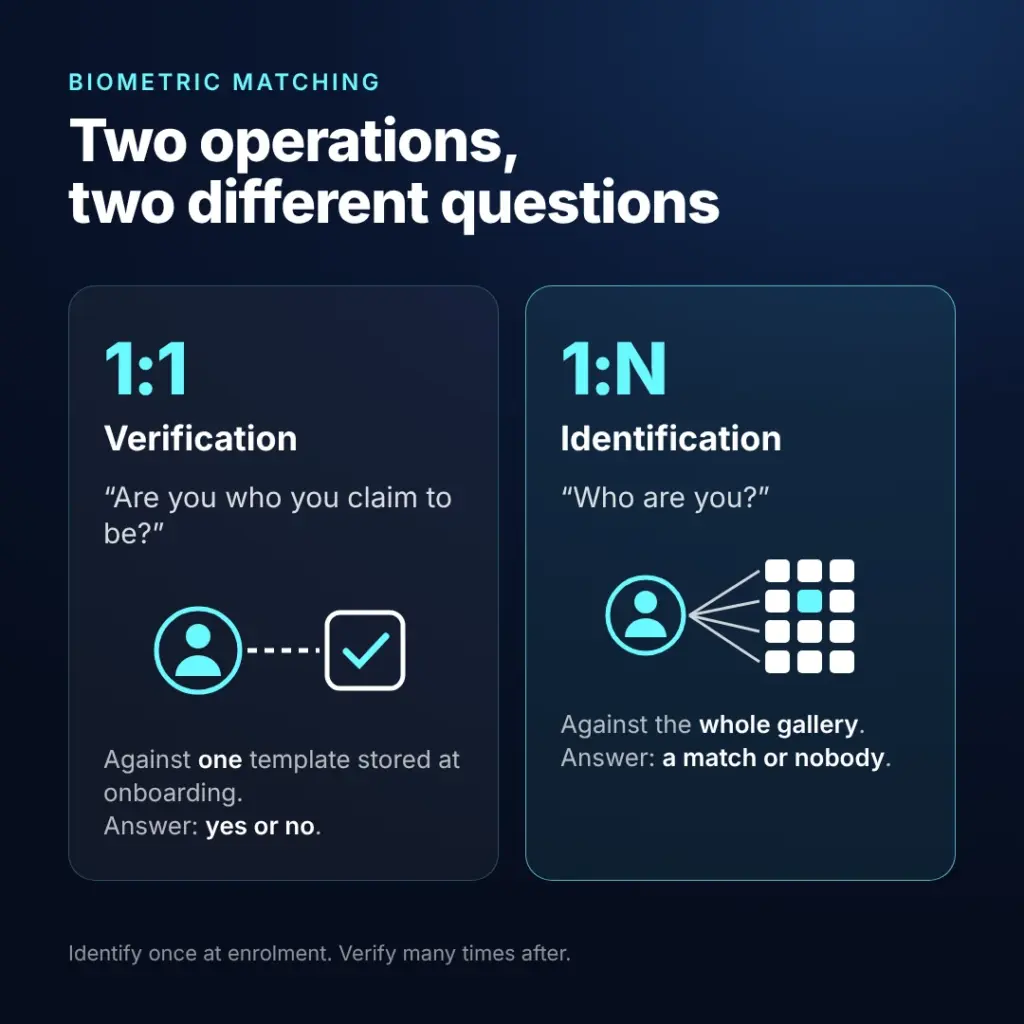
Verification, written 1:1. The subject claims an identity, usually by logging into an account or presenting a credential, and the system compares a fresh capture against the biometric template recorded for that identity when it was first enrolled. The answer is yes or no. The typical case is identity verification after a successful onboarding: the customer enrolled their face during onboarding, and every later login, high-value transaction or account recovery is checked against that stored reference.
Identification, written 1:N. No claim is made. The system searches the biometric against the entire enrolled gallery and returns whoever matches, or nobody. Finding a person in a national registry, checking a watchlist, and deduplicating an enrolment are all identification.
ISO/IEC 2382-37 defines this vocabulary formally, which is worth citing in a procurement document when different suppliers use the terms loosely.
Deepfakes are becoming more sophisticated, increasing the risk of fraud and identity manipulation in digital environments. Download our 10-step guide to learn how to detect threats early and protect your organization with proven best practices.
Why 1:N is a harder problem than it looks
In a 1:1 comparison, one wrong answer is one wrong answer. The relevant error rates are the false match rate and the false non-match rate.
In a 1:N search, the system performs a comparison against every enrolled record. Each of those comparisons carries a small probability of a false match. As the gallery grows, those small probabilities accumulate, and the chance that some wrong candidate ranks above the correct one increases with it.
The practical consequence is that an algorithm with excellent 1:1 numbers can perform poorly at 1:N against ten million records. This is why the error metrics change name for identification, to false positive identification rate and false negative identification rate, and why NIST evaluates the two scenarios in separate programmes.
When comparing vendors, insist on 1:N figures at a gallery size comparable to yours. A 1:1 result tells you very little about identification performance.
Deduplication is identification, and real time is the hard case
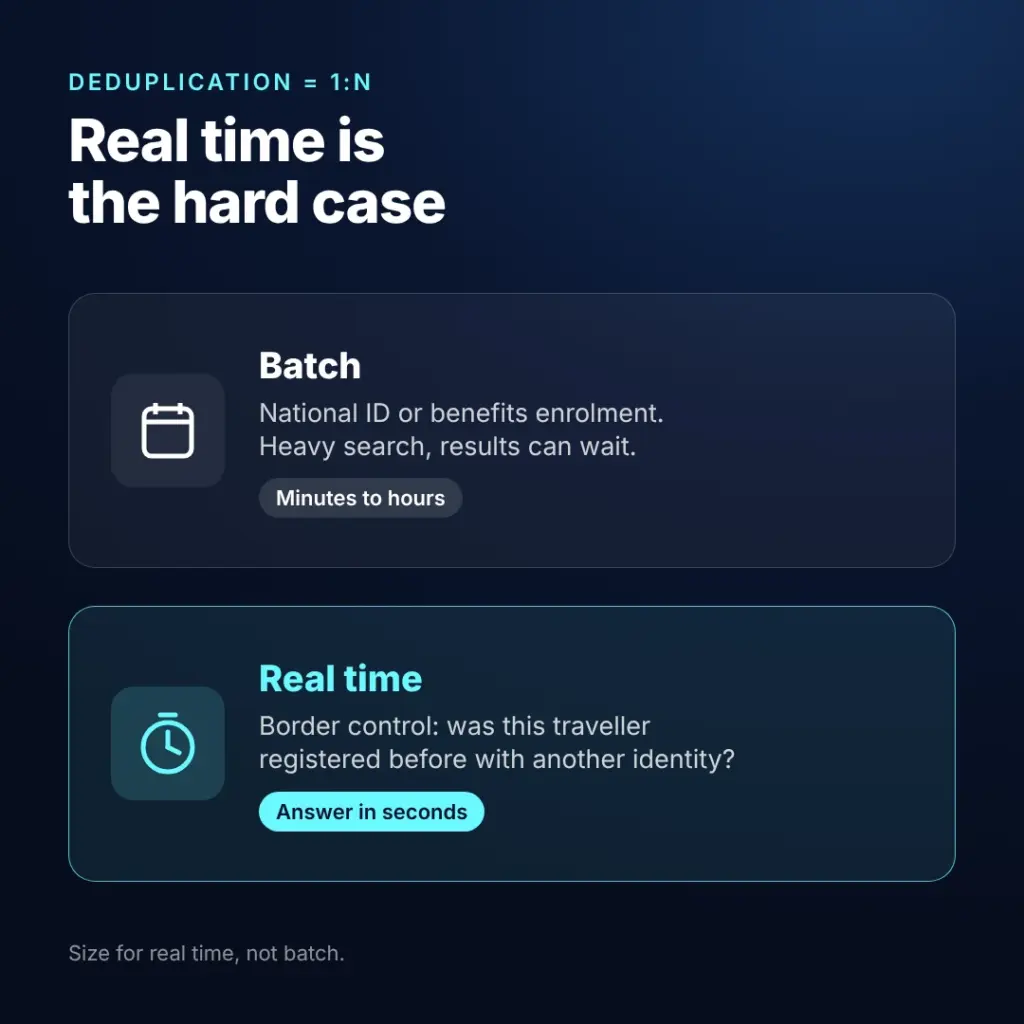
Deduplication is a 1:N search that checks whether a subject is already in the register under a different identity. It protects the integrity of the register, and it comes in two very different forms.
Batch deduplication runs when someone enrols in a programme such as a national ID or a benefits scheme. The search is heavy, but the result can arrive minutes or hours later, so jobs can be queued and processed when capacity allows.
Real-time deduplication is where the difficulty lies. Border control is the typical case: a traveller is captured at the checkpoint, and the system has to establish, while the person is standing there, whether they were previously registered with a different identity and a different passport. The full gallery search, the accuracy requirement and a latency budget of seconds all apply at once. Large border systems such as the EU Entry/Exit System are built around this requirement.
Three design decisions follow.
First, size the infrastructure for the real-time case, not the batch one. A matching engine that handles overnight deduplication comfortably can still fail a sub-second response target at the border.
Second, run deduplication on more than one modality where possible. A duplicate registration attempt is often deliberate, and a determined actor will degrade the modality they know is being checked. Face and fingerprint together close that gap.
Third, backfill matters. Adding deduplication to a system that already holds millions of records means running the whole historical population through the engine. Plan for it as a project, not a switch.
Where the two operations sit in a full identity lifecycle
A complete identity system chains both operations rather than picking one.
- Capture. The biometric is acquired and validated as coming from a live person. This is where presentation attack detection belongs, tested against ISO/IEC 30107-3, and where injection attacks have to be stopped, because no matching decision downstream can recover from a compromised capture. Identy.io processes capture on the device itself, so the biometric is validated where it is created.
- Verify. A 1:1 check against a claimed record. Fast, cheap, high volume.
- Identify. A 1:N search when no claim exists or when the claim must be tested against the whole population.
- Bind. The verified biometric is linked to a credential or an account, so the identity becomes reusable.
- Reuse. Subsequent interactions verify against the bound credential rather than re-running identification. This is what keeps cost under control at scale.
Systems that skip the bind step end up running 1:N searches for transactions that only ever needed 1:1, which is expensive and slower than it needs to be.
What to ask a vendor
Which evaluation, which participant submission, which gallery size. Whether 1:N figures are single modality or fused. What response time the engine sustains for a 1:N search at your gallery size, not just its throughput. How deduplication handles backfill. What happens at capture, specifically against injection. Whether templates use interchange formats you could migrate later.
Identy.io’s ABIS supports both 1:1 verification and 1:N identification across face and fingerprint, with a deduplication engine and configurable tolerance margins, and the underlying algorithms participate in NIST evaluations. What is ABIS covers the architecture, and the ABIS platform page sets out how Identy.io implements it.
Frequently asked questions
What is the difference between biometric verification and identification?
Verification is a one-to-one comparison. The subject claims an identity, typically by logging into an account after onboarding, and the system compares a fresh capture against the biometric template recorded for that identity at enrolment. The answer is yes or no.
Identification is a one-to-many search. No claim is made, and the system searches the biometric against the entire enrolled gallery to establish who the person is. ISO/IEC 2382-37 defines both terms formally.
Why is 1:N identification harder than 1:1 verification?
A 1:N search compares the submitted biometric against every enrolled record, and each comparison carries a small probability of a false match. As the gallery grows, the chance that a wrong candidate ranks above the correct one increases.
That is why identification uses its own metrics, the false positive and false negative identification rates, and why NIST evaluates it in separate programmes from one-to-one matching.
Is deduplication the same as identification?
Yes. Deduplication is a one-to-many search that checks whether the subject is already in the register under a different identity.
It can run in batch at enrolment, where the result can wait, or in real time. Border control is the typical real-time case: a traveller has to be checked against previous registrations under other identities and passports while they are still at the checkpoint. Real-time deduplication is the most demanding case because it needs accuracy and an immediate response at the same time.
Should a system use 1:1 or 1:N?
Most real programmes use both, in sequence. Identification runs once at enrolment to confirm the subject is unique. The identity is then bound to a credential, and later interactions use one-to-one verification against that credential.
Running 1:N searches for transactions that only need 1:1 raises cost and latency without improving assurance.
Where do presentation attacks fit into this?
At capture, before either operation runs. Presentation attack detection is tested against ISO/IEC 30107-3 and determines whether the biometric came from a live person.
Injection attacks bypass the sensor and feed a synthetic stream into the application, so they also have to be stopped at the capture layer. No matching engine can recover from a compromised capture.
References
- ISO/IEC 2382-37:2022. Information technology — Vocabulary — Part 37: Biometrics. https://www.iso.org/standard/73514.html
- ISO/IEC 19795-1. Biometric performance testing and reporting — Part 1: Principles and framework.
NIST. Face Recognition Technology Evaluation (FRTE) 1:N Identification. https://pages.nist.gov/frvt/html/frvt1N.html - NIST. FRIFTE E1N —Fingerprint 1:N Identification Results. https://fingerprint.nist.gov/frifte/e1n/results/
- NIST. Proprietary Fingerprint Template (PFT) III. https://www.nist.gov/itl/iad/image-group/proprietary-fingerprint-template-pft-iii
- ISO/IEC 30107-3:2023. Biometric presentation attack detection — Part 3: Testing and reporting. https://www.iso.org/standard/79520.html
- iBeta Quality Assurance. ISO 30107-3 Presentation Attack Detection Test Methodology. https://www.ibeta.com/iso-30107-3-presentation-attack-detection-confirmation-letters/
- Department of Homeland Security. Biometrics. https://www.dhs.gov/biometrics
- Regulation (EU) 2017/2226 of the European Parliament and of the Council establishing an Entry/Exit System (EES). https://eur-lex.europa.eu/eli/reg/2017/2226/oj