
Table of Contents
ToggleBiometric verification is only as strong as its ability to know a real human is in front of the camera. Liveness detection software is the anti-fraud layer that makes that determination — rejecting printed photos, screen replays, 3D masks, synthetic identities and injected deepfakes before they ever reach the matching engine. If you are new to the concept, start with our foundational explainer on what a liveness check is and why it matters in facial biometrics; this page focuses on how the software works, how it is certified, and how to evaluate it.
Deepfakes are becoming more sophisticated, increasing the risk of fraud and identity manipulation in digital environments. Download our 10-step guide to learn how to detect threats early and protect your organization with proven best practices.
Why Liveness Is the Core of Biometric Fraud Prevention
Face matching answers ‘is this the same person?’. Liveness answers a prior and more important question: ‘is this a person at all?’ Fraud rings no longer need to defeat the match — they need to defeat presence. Generative AI has industrialized that attack: deepfake tools can animate a stolen selfie in minutes, and virtual camera software can inject that video directly into an onboarding flow. Without certified liveness, a biometric system is a lock that accepts photographs of keys.
The financial impact is measurable across account opening fraud, account takeover, synthetic identity fraud and money-mule onboarding — the four attack patterns that liveness directly interrupts.
The Attacks Liveness Detection Software Stops
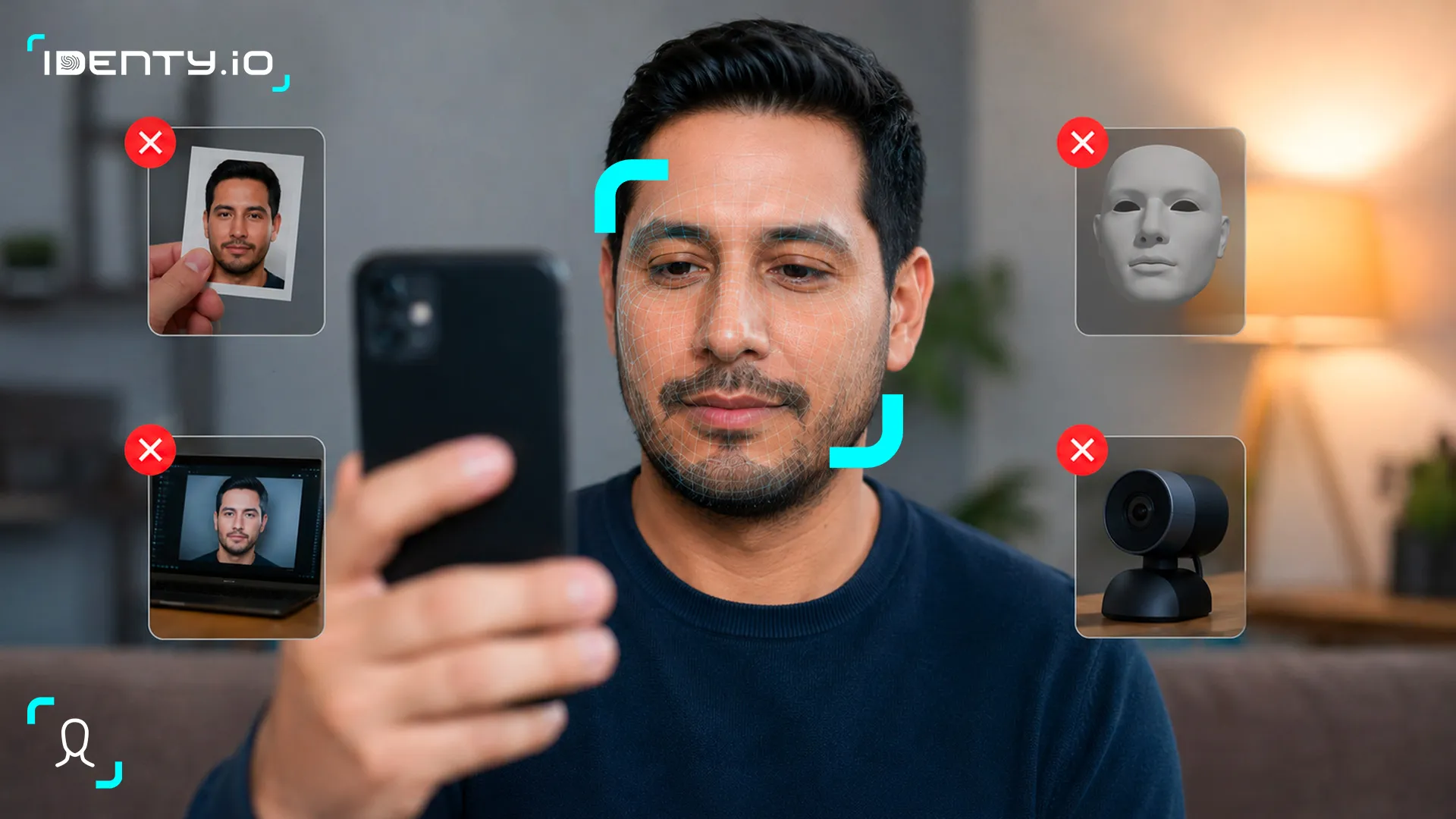
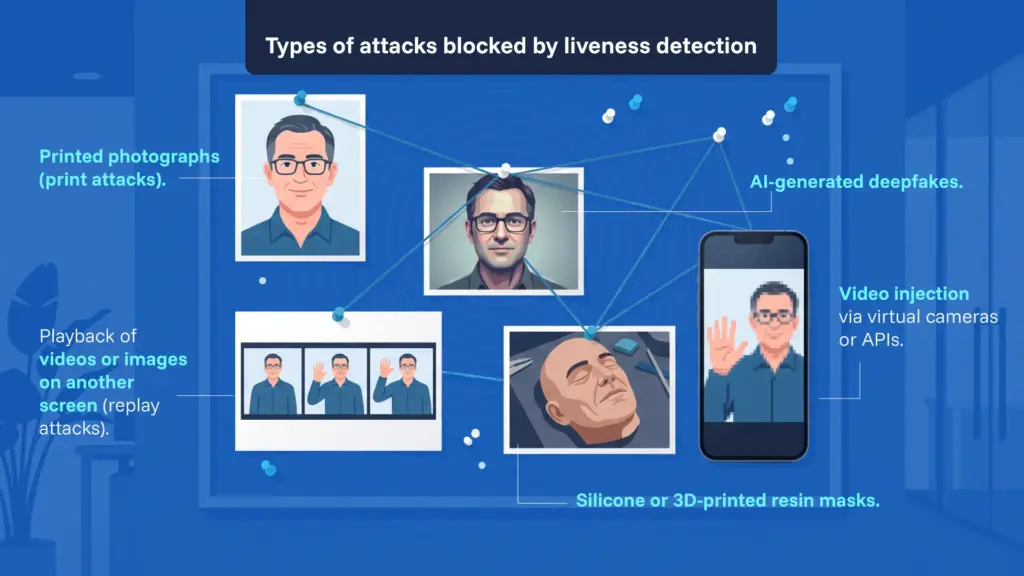
- Print attacks: photographs of the victim presented to the camera — the entry-level spoof.
- Replay attacks: videos or photos displayed on a phone, tablet or monitor.
- 3D mask attacks: silicone or resin masks reproducing the victim’s facial geometry (the Level 2 test threshold).
- Deepfake presentation: AI-generated video of the victim shown on screen. See how it works in deepfake biometric verification.
- Injection attacks: synthetic media injected via virtual cameras or intercepted APIs, bypassing the physical camera entirely — the fastest-growing vector and the reason camera-integrity signals now matter as much as image analysis.
Get a tailored demo of our contactless biometric platform and see how it fits your specific use case.
Active vs Passive Liveness Detection
Active liveness
Passive liveness
A single frame or a short passive capture is analyzed for texture, depth cues, micro-reflections, moiré patterns and signs of synthesis. The user does nothing. Passive liveness is now the industry direction because it combines lower abandonment with equal or better presentation attack detection, and it extends naturally beyond face to contactless fingerprint and palm capture.
Certification: ISO/IEC 30107-3 and PAD Levels
Vendor claims about anti-spoofing are only meaningful when tested by an accredited third party against ISO/IEC 30107-3, the international standard for presentation attack detection (PAD). Independent labs such as iBeta test at two levels:
- PAD Level 1: printed photos, screen replays and basic 2D artifacts.
- PAD Level 2: 3D masks and sophisticated artifacts with a larger attack budget — the enterprise benchmark.
Identy’s technology has passed ISO 30107-3 PAD Level 2 evaluation with a 0% penetration rate; the details are on our PAD Level 2 certification page.
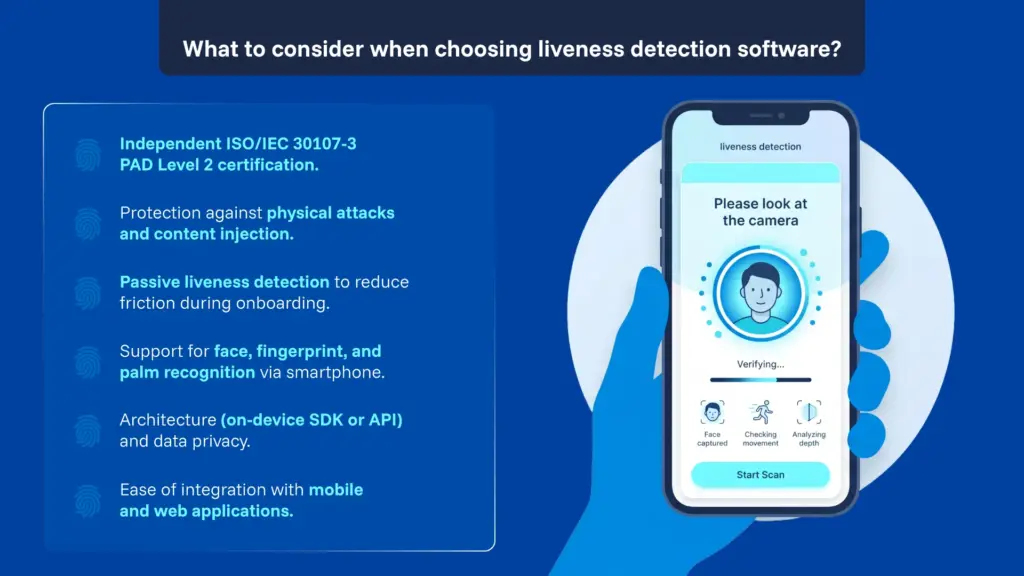
How to Evaluate Liveness Detection Software
- Certification: ISO/IEC 30107-3 Level 2 by an accredited lab, not internal testing.
- Attack coverage: presentation AND injection attacks, including deepfake detection — compare options in our review of the best deepfake detection software.
- User experience: passive capture, sub-second decisions, low false rejection on real users across demographics and devices.
- Modality breadth: face, contactless fingerprint and palm liveness from a standard smartphone camera.
- Deployment model: on-device SDK vs server API, offline capability, and data-privacy architecture (templates never leaving the device where required).
- Integration effort: native mobile and web SDKs with clear documentation — explore the biometric SDK suite.
Get a tailored demo of our contactless biometric platform and see how it fits your specific use case.
Frequently Asked Questions
What is liveness detection software?
It is software that confirms the biometric sample presented to a camera comes from a live, physically present person — not a photo, replay, mask or deepfake. It is the anti-fraud layer of any biometric verification or authentication flow.
What is the difference between active and passive liveness detection?
Active liveness asks the user to perform actions; passive liveness analyzes the capture with no user action. Passive delivers lower abandonment with equal or better attack detection.
What is ISO/IEC 30107-3 PAD certification?
The international standard for testing presentation attack detection. Accredited labs test at Level 1 (photos, replays) and Level 2 (3D masks and sophisticated artifacts). Level 2 is the enterprise benchmark.
Can liveness detection stop deepfakes?
Yes. Modern engines combine texture, depth and motion analysis with injection-attack detection to catch synthetic media, whether presented on a screen or injected into the camera feed.
Bibliography
- ISO/IEC 30107-3 — Biometric presentation attack detection, Part 3: Testing and reporting. https://www.iso.org/standard/79520.html
- iBeta Quality Assurance — Biometrics PAD testing (Levels 1 & 2). https://www.ibeta.com/biometrics-testing/
- NIST — Face Analysis Technology Evaluation (FATE) / PAD track. https://www.nist.gov/programs-projects/face-technology-evaluations-frtefate
- Europol (2024) — Facing reality? Law enforcement and the challenge of deepfakes / AI and policing reports. https://www.europol.europa.eu/publications-events/publications
- FATF (2020) — Guidance on Digital Identity. https://www.fatf-gafi.org/en/publications/Fatfrecommendations/Guidance-on-digital-identity.html