
Table of Contents
ToggleBiometric authentication confirms a returning user’s identity through a unique biological trait (face, fingerprint or palm) instead of a password or token. Because the credential is the person, it cannot be phished, shared, reused across services or forgotten. This guide explains how biometric authentication works, the main methods and their trade-offs, how it differs from identity verification, and what it takes to deploy it on any smartphone without special hardware.
Deepfakes are becoming more sophisticated, increasing the risk of fraud and identity manipulation in digital environments. Download our 10-step guide to learn how to detect threats early and protect your organization with proven best practices.
What Is Biometric Authentication?
Biometric authentication is the second half of the digital identity lifecycle. Verification establishes who you are once, at onboarding; authentication proves you are still you every time you return. Technically, a live biometric sample is captured, converted into a mathematical template, and compared against the template enrolled at verification. A match above threshold grants access; everything else is rejected or escalated.
Three properties make biometrics superior to knowledge-based credentials: they are unique to each individual, always present (nothing to remember or carry), and when protected by liveness detection hard to steal in usable form, because a photo of a face is not a face.
How Biometric Authentication Work
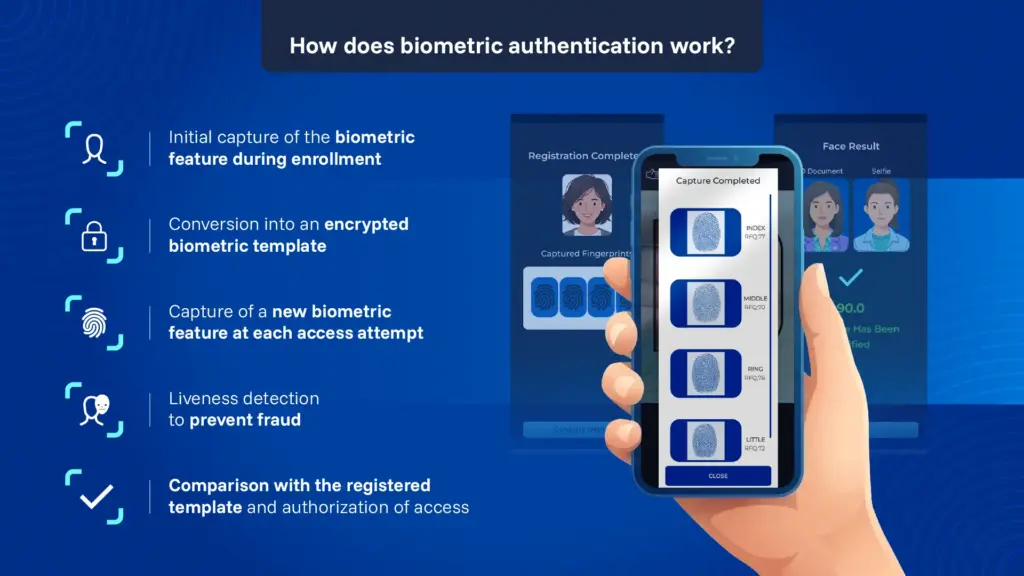
- Enrollment. During onboarding, the user’s biometric trait is captured and transformed into an encrypted template. Raw images are discarded; templates are stored on-device or in a secure enclave depending on the privacy architecture.
- Capture. On each login or transaction, the user presents the trait to the device camera or sensor.
- Liveness check. The system confirms a live human is present, blocking photos, replays, masks and deepfakes — the anti-fraud layer we cover in depth in our guide to liveness detection software.
- Matching. The fresh template is compared to the enrolled one; a similarity score above threshold authenticates the user in under a second.
Get a tailored demo of our contactless biometric platform and see how it fits your specific use case.
Biometric Authentication Methods
Facial recognition
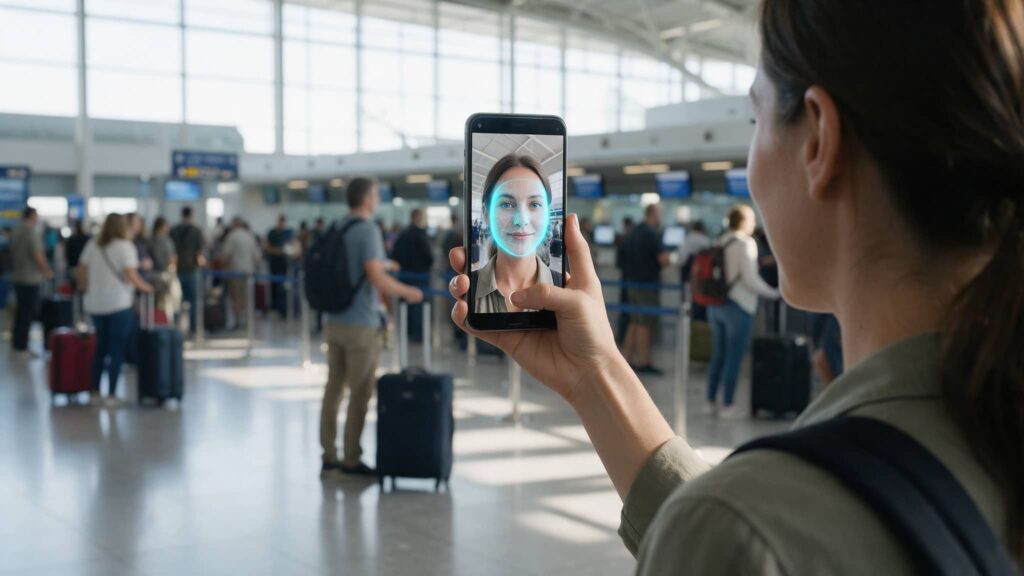
The most frictionless method: the front camera captures the face passively during app use. Modern engines handle pose, lighting and aging, and pair with passive liveness for spoof resistance. Developers integrate it through a facial recognition SDK.
Fingerprint recognition
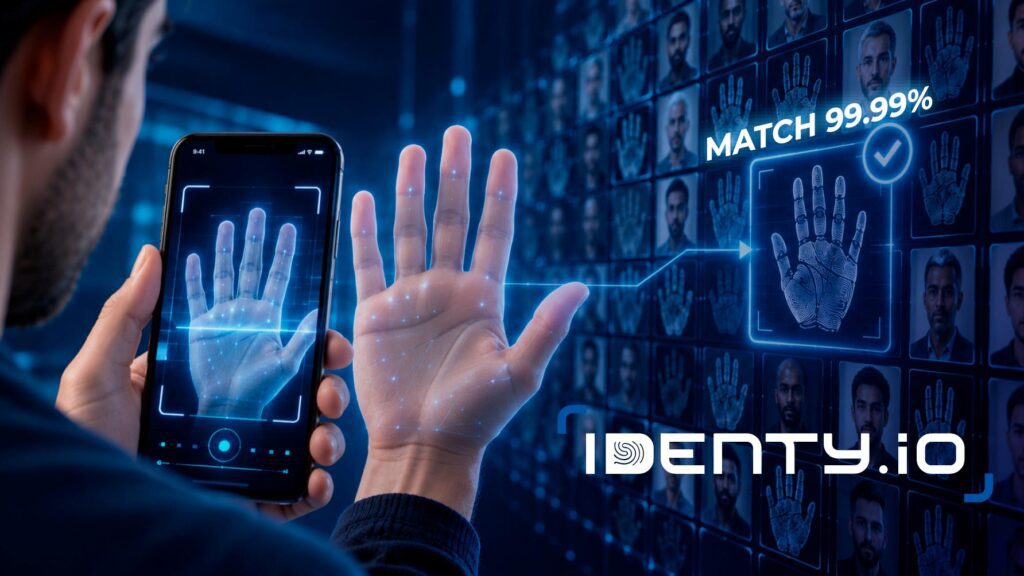
The most established modality. Beyond capacitive sensors, contactless fingerprint capture photographs the fingerprints with the standard rear camera and matches them against sensor-enrolled or card-enrolled prints, enabling deployment on any device — see the finger biometric SDK.
Palm recognition
Palm prints offer a large, stable trait that captures well at a distance with a phone camera, tolerating dirt and minor injuries better than fingerprints — a strong fit for workforce and financial-inclusion scenarios via the palm biometric SDK.
Other modalities and combinations
Iris and voice recognition serve niche high-security and hands-free contexts. Combining two or more traits raises assurance further; we analyze that approach in multimodal biometrics, the future of digital authentication.
Biometric Authentication vs Passwords, OTPs and Tokens
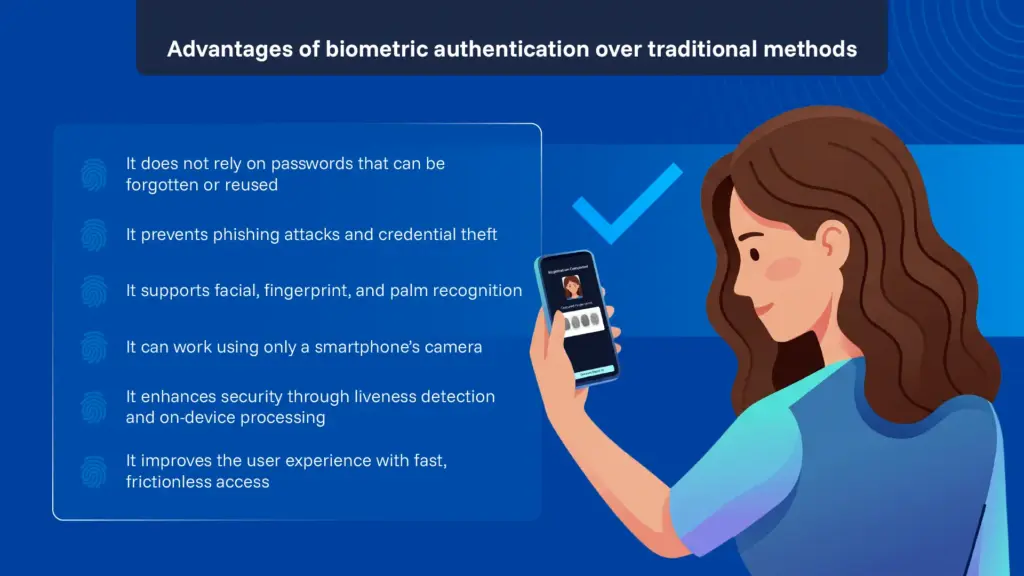
Passwords fail through phishing, reuse and credential-stuffing; SMS OTPs fail through SIM-swap; hardware tokens are costly and losable. Biometrics eliminate the shared secret entirely: there is nothing to intercept that can be replayed, provided the system enforces certified liveness. This is why frameworks such as NIST SP 800-63B recognize biometrics as an authentication factor when bound to a device and protected by presentation attack detection, and why passwordless initiatives from the FIDO Alliance lean on device-bound biometrics.
Security: Anti-Spoofing and Privacy
Two questions decide whether a biometric system is trustworthy. First, can it be spoofed? Only solutions independently tested against ISO/IEC 30107-3 — such as Identy’s PAD Level 2 certified engine — can substantiate anti-spoofing claims. Second, where does the data live? Privacy-first architectures keep templates encrypted on-device, process matching locally where possible, and never store raw biometric images, aligning with GDPR’s treatment of biometric data as a special category.
Use Cases
- Banking and fintech: passwordless login, transaction signing and step-up authentication — detailed in face and fingerprint identification in banking and fintech.
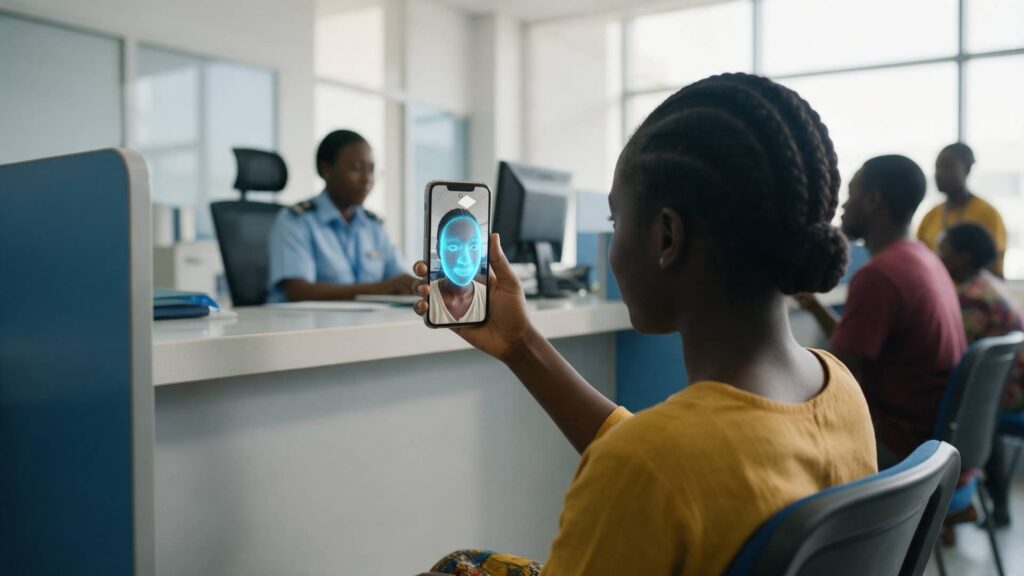
- Government services: citizen authentication for benefits, tax portals and digital ID programs.
- Enterprise workforce: shared-device login in retail, logistics and healthcare without badge or password friction.
- High-risk actions: payment release, account recovery and privilege escalation guarded by a biometric step-up.
Implementing Biometric Authentication with an SDK
Deployment reduces to one decision: hardware-dependent or contactless. Contactless SDKs use the existing smartphone camera for face, fingerprint and palm, which means every user’s device is already compatible. Evaluate accuracy benchmarks (NIST testing), liveness certification, on-device processing options, offline support and integration effort. The Identy biometric SDK covers all three modalities with passive liveness in native mobile and web packages.
Get a tailored demo of our contactless biometric platform and see how it fits your specific use case.
Frequently Asked Questions
What is biometric authentication?
The process of confirming a returning user’s identity using a unique biological trait — face, fingerprint or palm — by comparing a live sample against a previously enrolled template.
What are the main biometric authentication methods?
Facial recognition, fingerprint recognition (including contactless capture), palm recognition, iris and voice. Multimodal systems combine several traits for higher assurance.
Is biometric authentication more secure than passwords?
Yes. Biometric traits cannot be phished, reused or forgotten, and certified liveness detection makes them resistant to spoofing — unlike passwords, the leading cause of account compromise.
What is the difference between biometric authentication and identity verification?
Verification happens once at onboarding against an official document; authentication happens on every return visit to confirm the same person is back.
Can biometric authentication work without special hardware?
Yes. Contactless SDKs capture fingerprints, palms and faces with the standard smartphone camera, extending biometric security to every device.
- NIST SP 800-63B — Digital Identity Guidelines: Authentication and Lifecycle Management. https://pages.nist.gov/800-63-4/
- NIST — Face Technology Evaluations (FRTE/FRVT). https://www.nist.gov/programs-projects/face-technology-evaluations-frtefate
- FIDO Alliance — User Authentication Specifications (passwordless / passkeys). https://fidoalliance.org/specifications/
- ISO/IEC 30107-3 — Biometric presentation attack detection, Part 3. https://www.iso.org/standard/79520.html
- EDPB / GDPR Art. 9 — Processing of special categories of personal data (biometric data). https://gdpr-info.eu/art-9-gdpr/