
Table of Contents
ToggleGiving People Back Their Identity: How Mobile Fingerprinting Is Helping Solve Unidentified Person Cases
In 2025 alone, nearly 500,000 missing person records were entered into the FBI’s National Crime Information Center. But even when someone is found, the challenge of determining who they are remains. Without reliable identification or the ability to communicate, connecting an unidentified person with their name and family can require an extensive investigation. Until providers establish the patient’s identity, the patient and their family may be unable to participate in critical care decisions.
That was the challenge facing a social worker when an unidentified patient arrived at a Southern California hospital unable to communicate. The patient had no phone, no reliable identification and no family members at their bedside who could provide answers.
This social worker has encountered unidentified people throughout her career, including while working in drop-in shelters. Some had lived on the streets for so long that the names they used were no longer necessarily their legal identities, but nicknames they’ve used their entire lives. In situations like those, quickly capturing fingerprints could provide another way to find an answer.
For the hospital social worker assigned to the case, the search for an identity began with combing through the patient’s electronic medical record for a name, address and phone number. She checked their belongings, spoke with nurses and reviewed the EMS run sheet to determine where the patient had been picked up.
The address led her to a nearby motel, but a call there produced another dead end. The only identification the motel had on file could not be used to confirm the patient’s identity. At the hospital, social workers have a binder filled with missing-person flyers and other resources that they can consult when alternate methods fail. She combed through the materials looking for someone who matched her patient, but didn’t find a match.
With traditional options running out, she contacted the Los Angeles Police Department’s Missing Persons Unit who recommended checking fingerprints.
Turning a Smartphone Into an Identification Tool
Members of the Los Angeles Police Department Missing Persons Unit had been introduced to My Family ID, a mobile application that uses Identy.io‘s touchless fingerprint technology to capture fingerprints using a standard smartphone camera.
The technology was originally brought to My Family ID with the goal to make it easier to preserve identifying information that could help law enforcement reunite missing people with their families. Through the collaboration, My Family ID replaced the need for paper-based fingerprint records with high-resolution digital fingerprints that can be captured from a mobile device and used by law enforcement identification systems.
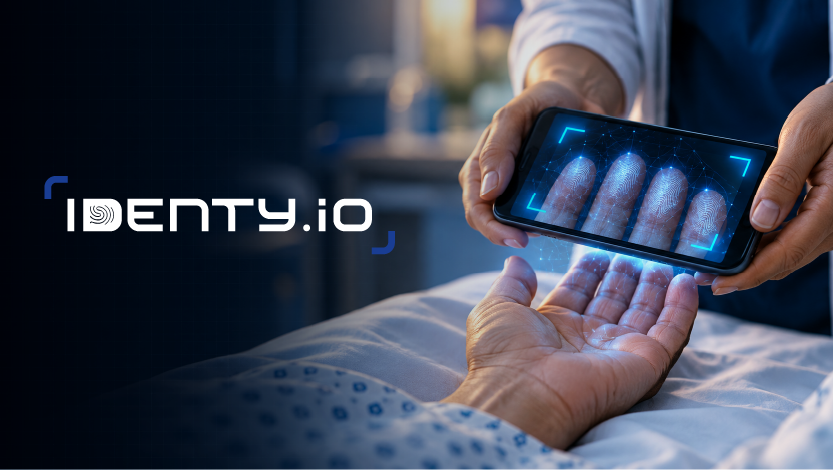
Through a mutual contact, the LAPD MPU introduced the social worker to the My Family ID app. With the app, the social worker easily captured the unidentified patient’s fingerprints herself following the app’s walkthrough detailing how to position the patient’s fingers and capture usable images. Once collected, the app shared the fingerprints with the LAPD for comparison.
Within 24 hours, the fingerprints helped law enforcement identify the patient. With a name finally available, the social worker was able to locate the patient’s family, who traveled to the hospital and provided the answers that weeks of searching had not.
The social worker noted that this experience changed how she’d approach a similar case in the future. While the identification process traditionally requires exhausting one investigative avenue after another, she said that with the application readily available, she would use the My Family ID app first in the future.
Giving People Back Their Identity
For Charles Still, founder of My Family ID, making fingerprint capture simple enough for someone without specialized equipment or extensive training was essential. With Identy.io’s technology, individuals can use the camera and LED flash already built into a smartphone to capture high-quality fingerprints without a traditional fingerprint scanner.
The software can capture all 10 fingerprints and was designed to accommodate differences in finger and hand size while guiding users through the process. Fingerprint data is processed locally on the device and the resulting images are compatible with traditional law enforcement fingerprint identification systems.
As mobile fingerprint capture becomes available in more environments, ensuring the technology can distinguish a real person from an attempted spoof is equally important.
Identy.io’s Finger AI application recently completed iBeta Level 1 Presentation Attack Detection testing in accordance with ISO/IEC 30107-3. Across 1,800 presentation attacks conducted on two devices, iBeta was unable to achieve a false liveness classification, resulting in a 0% Attack Presentation Classification Error Rate.
The testing adds another layer of validation to technology designed around the premise that reliable fingerprint capture should not depend on access to specialized hardware.
For families, that can mean having identifying information available before an emergency happens. For social workers and others trying to identify individuals, it can offer a faster way to resolve cases when traditional methods have failed. And sometimes, as one hospital social worker discovered, a smartphone and a fingerprint can help give someone back their identity.
In the end, the patient’s own biometrics provided the identification that a driver’s license or hospital wristband could not. Biometrics couldn’t be lost, forged or left behind, allowing the patient to become the key to their own identity.