
Table of Contents
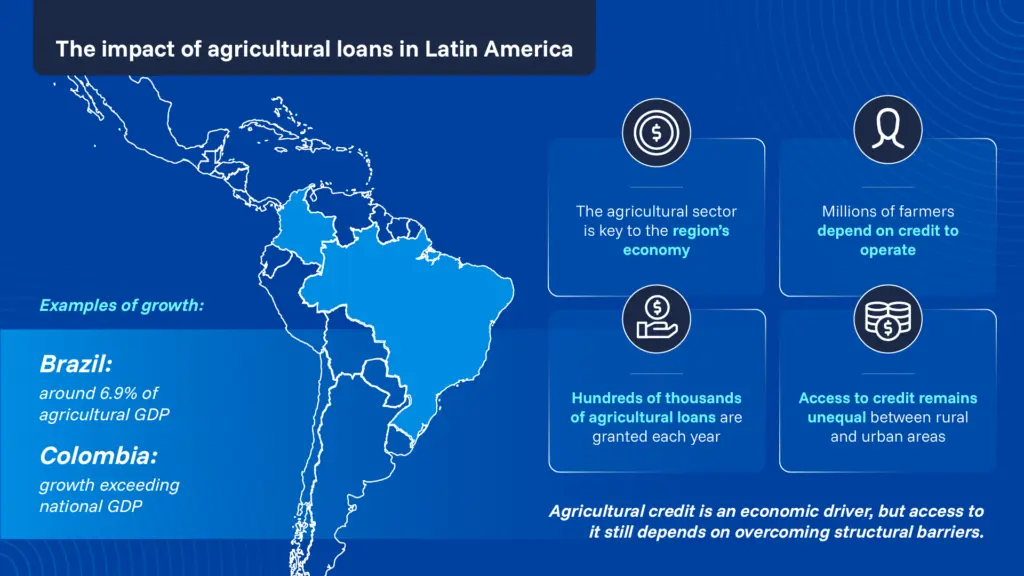
ToggleThe agricultural sector remains one of the main economic drivers throughout Latin America. In Brazil, this industry accounts for nearly 6.9% of GDP, according to data from the Brazilian Confederation of Agriculture and Livestock (CNA), while in Colombia, the growth in agricultural value added was 4.1% last year, exceeding the national GDP, which stood at 2.8%.
Much of this growth is attributable to the granting of agricultural loans, which are essential in many cases to cover the costs of starting and maintaining these businesses. In Colombia, for example, more than 395,000 agricultural loans were granted in 2025, totaling a record $48.1 billion, while in Peru, 52,000 producers benefited from more than S/ 839 million in aid.
Although the agricultural sector is increasingly turning to digitalization as a tool to streamline a wide range of administrative procedures—especially when it comes to dealing with financial institutions—the reality is that this shift is still uneven. In countries like Brazil, where there are vast distances between rural areas and major cities, and where access to digital tools is uneven, not all producers have the same opportunities to conduct their business without having to travel to financial institutions’ offices.
Biometrics as a driver of financial inclusion
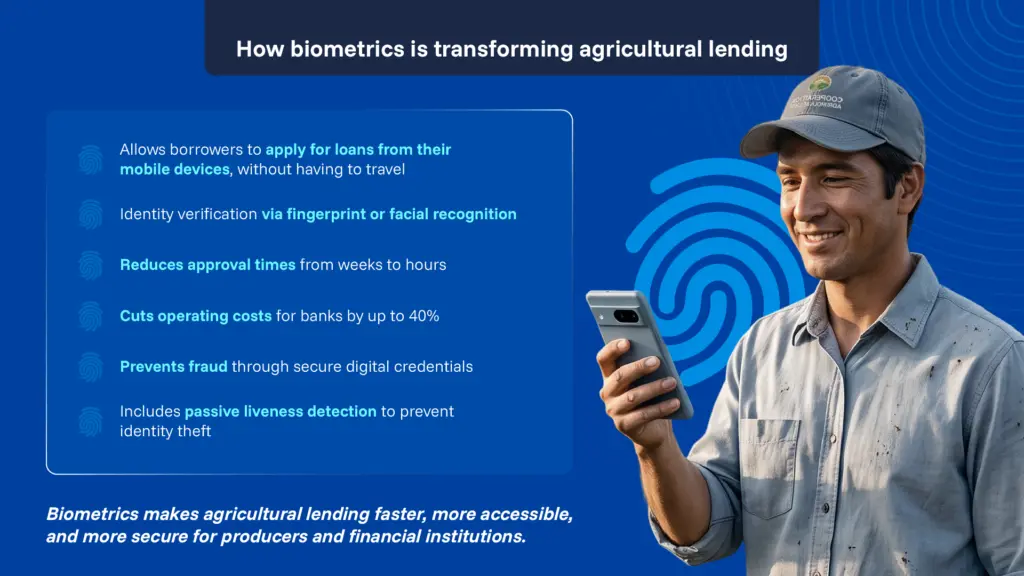
Let’s imagine the case of a farmer who has to travel hundreds of miles from his home to the nearest bank branch. For him, beyond the time investment required to complete the process, applying for a new agricultural loan would cost hundreds of dollars—an expense he might not be able to afford, depending on his financial situation. In such cases, biometrics proves to be a strategic tool for ensuring that any producer, regardless of where they live or their ability to travel, can conveniently apply for an agricultural loan at any time with complete security.
Operationally, this substantial change in how people interact with banks also brings significant time-saving benefits. While until not too long ago it was necessary to wait between 15 and 45 days to access the loan once applied for, thanks to the biometrics-based online application, this time can be reduced to just 48 hours. And for banks, this technology can lead to a reduction of up to 40% in operating costs, according to forecasts by McKinsey & Company.
However, as with any other online procedure, the ability to complete these processes remotely carries with it the risk of fraud and identity theft. For this reason, biometrics has established itself as a new layer of security that, beyond simplifying the process of applying for agricultural loans, helps protect users and financial institutions from the risks associated with identity theft.
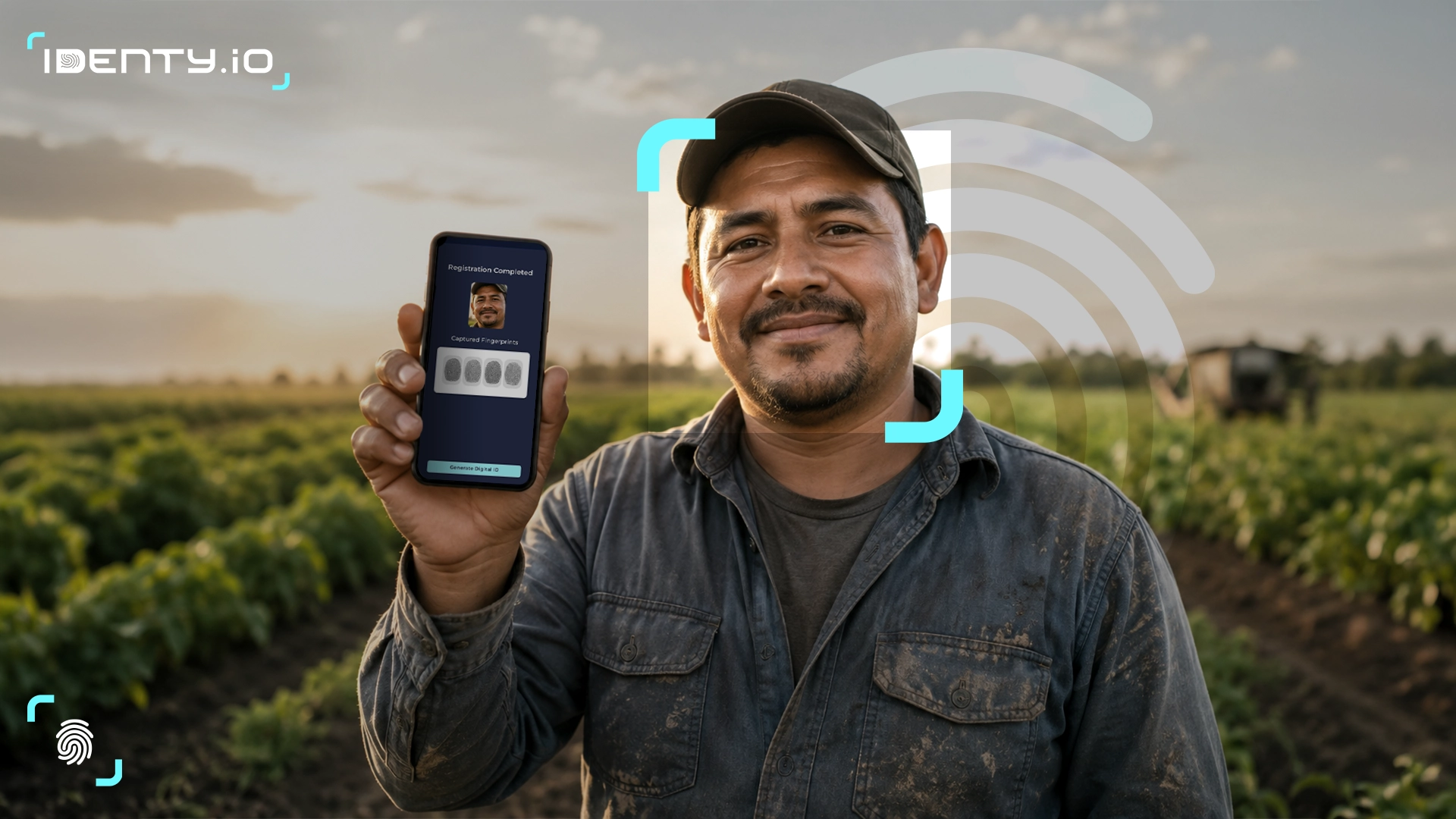
In this context, companies like Identy.io have developed a suite of biometric-based solutions that help verify a user’s identity quickly and easily, right from their own mobile phone. Once the user completes the registration process, during which their digital credentials—such as fingerprints or facial features—are captured, the system stores all their digital information on their own phone to make it easier to perform subsequent checks against a centralized database, thereby verifying the user’s identity and ensuring they are who they claim to be in any type of transaction. Additionally, the BioCode QR — a compact, encrypted container holding biographical information and user’s facial and fingerprint data, cryptographically signed by the issuing institution — can be stored in a digital wallet or even printed, making identity credentials available whenever and wherever they’re needed.
The use of biometrics is not only beneficial for end users, but financial institutions also derive clear benefits from its implementation. For example, the report “Financial Data Unbound” by the consulting firm McKinsey estimates that dropout rates for loan applications processed digitally are 30% to 45% lower than those for traditional manual workflows. Similarly, this report shows that the cost per loan origination is reduced by 30 to 40%, allowing banks to make more aggressive offers without compromising their profit margins. For example, in Brazil, it is estimated that the ability to apply for loans remotely could reduce dropout rates by up to 29% and decrease data duplication and errors in applications by up to 18%, according to the specialized consulting firm Ken Research.
And in a context where cases of identity theft using deepfakes and digital doubles are becoming increasingly common, biometrics is establishing itself as the ideal tool to provide an additional layer of security in transactions. In the case of Identy.io’s biometric solutions, the incorporation of passive liveness detection technology—meaning it requires no movement or predefined action to verify that the user accessing the system is a real person and not a digital entity created by artificial intelligence—makes this type of identity theft virtually impossible.