
Table of Contents
ToggleThe digitization that the healthcare sector is undergoing, through the integration of different digital technologies in areas such as prevention or the treatment and monitoring of diseases, represents one of the biggest changes that this industry has undergone in recent years. This innovation has transformed the way patients and medical staff interact with the system.
One of the pillars of this transformation is the electronic health record, which allows medical information to be stored and shared securely and efficiently. Thanks to this, different professionals can access the same file in real time, reducing and improving continuity of care. Telemedicine is another key element. Through video calls, digital platforms, and mobile applications, patients can consult with specialists without having to travel. Telemedicine not only significantly improves access to medical care in rural areas, but also optimizes the system’s time and resources.
However, access to these resources is not equal for all countries and their different regions, which often face territorial inequalities and budgetary constraints. Thus, the focus is not always on implementing highly advanced technologies, but rather on strengthening basic infrastructure and expanding coverage to ensure that all citizens can benefit, regardless of their place of residence or socioeconomic status.
How to ensure secure access to digital health
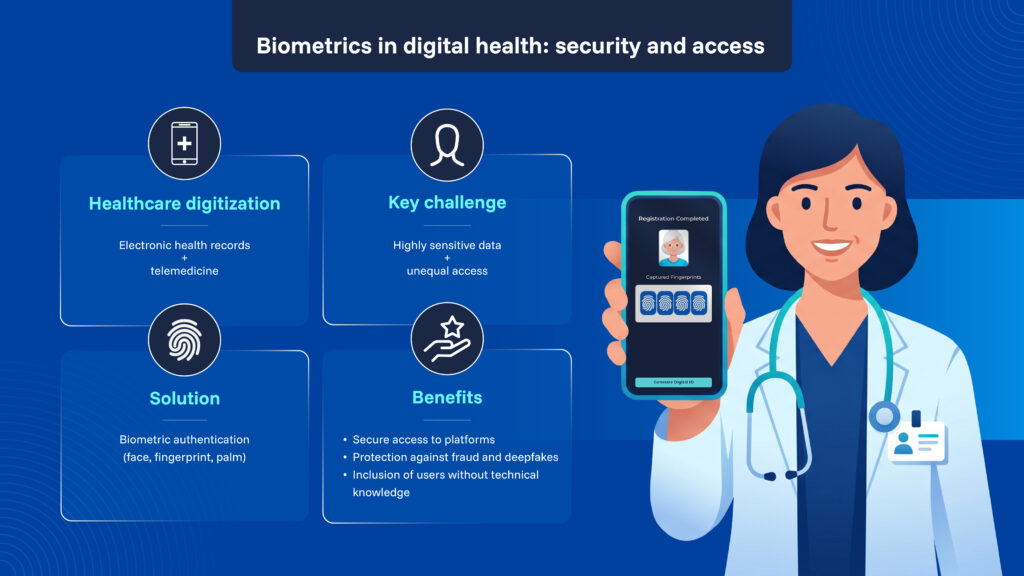
In turn, digital health handles a person’s most sensitive data, such as medical records, diagnoses, and prescription medications. Protecting this information is therefore essential to ensure patient privacy and ensure that only the right people have access to this critical information. In this context, biometrics is positioned as the solution that guarantees security, unlike passwords or single-use codes, as it allows a person’s identity to be linked to unique and non-transferable physical characteristics. In this context, thanks to biometric recognition of the user’s face, fingerprints or palm using passive liveness technology, the Identy.io platform is able to identify the user in a way that is virtually impossible to falsify, even detecting the use of 3D masks or deepfakes created using artificial intelligence.
The innovative contactless biometric verification solutions from Identy.io can be integrated directly into the patient’s mobile phone, facilitating secure access to health portals, official applications, and remote care systems. Through their device, users can quickly and easily authenticate themselves using their own biometrics, creating a unique link between their identity and their digital medical record. The solution’s intuitive interface and simple operation make it accessible even to older people or those without digital training, which is especially important for promoting the inclusion of these population groups and ensuring their access to social and health services.
Biometrics as a guarantee of correct medication dispensing
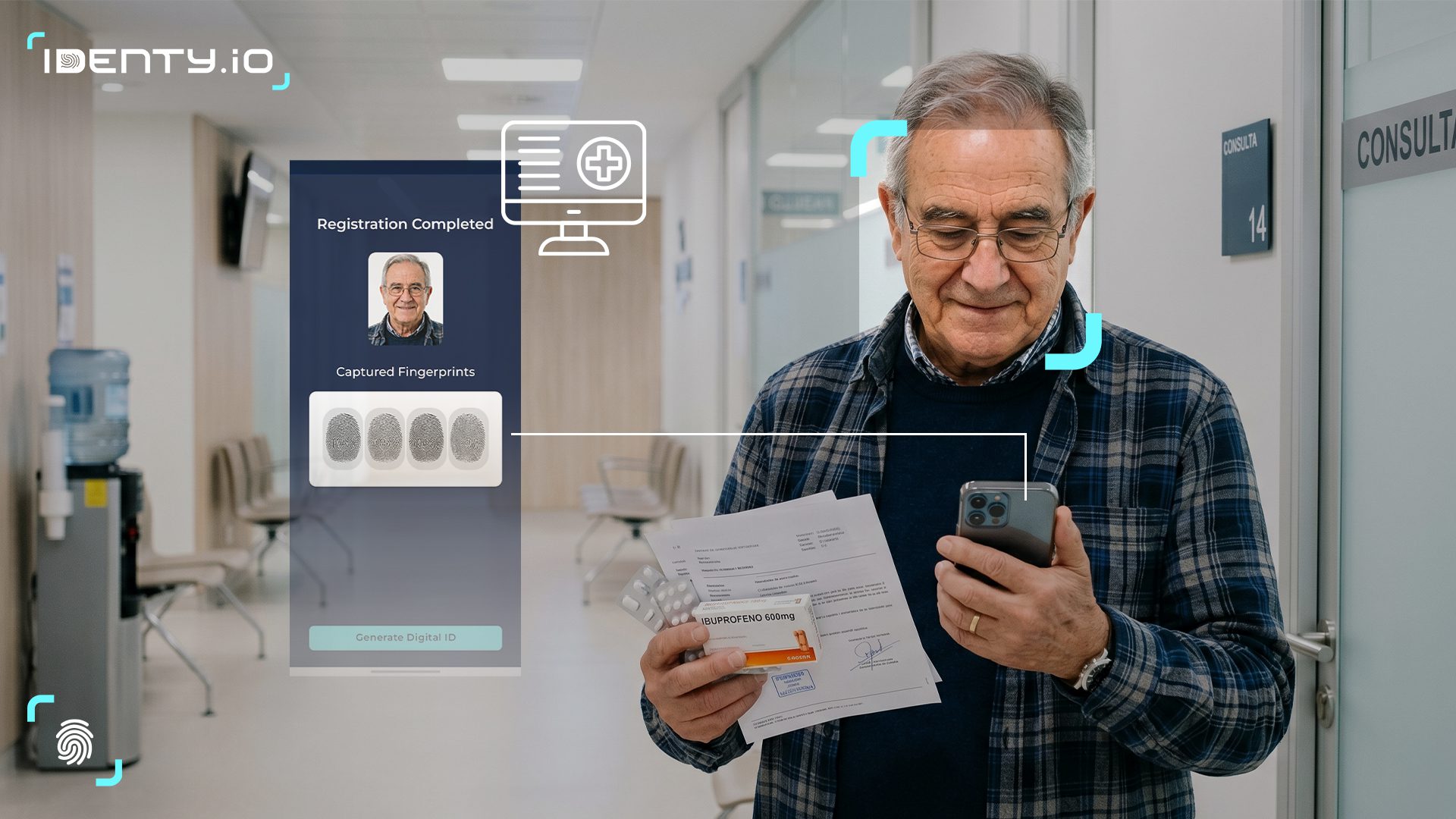
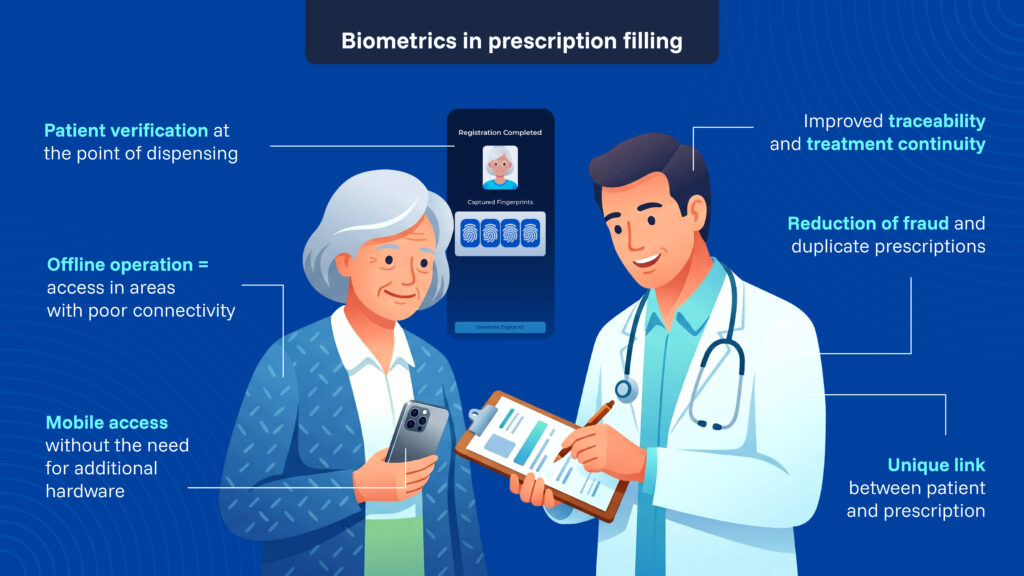
Biometrics not only protects secure access to platforms and clinical data, but is also a key pillar in ensuring the correct dispensing of medications, which is a real critical point in the care chain. Biometric authentication at the point of dispensing allows verification that the person collecting the medication is actually the prescription holder, reducing fraud and duplication. In addition, biometrics strengthens traceability and therapeutic continuity because, by uniquely linking the patient to their clinical history, duplicate delivery of medications and dosing errors are avoided.
Unlike traditional systems that require patients to travel to kiosks with specialized biometric scanners, Identy.io’s contactless biometric verification solutions are mobile-first, so they integrate seamlessly with patients’ mobile devices. This allows them to present their credentials at dispensaries when picking up medications and ensure they are receiving the correct treatment, even if they share the same first and last names as another patient. This is because the device generates a unique and non-transferable token that links each prescription to its patient.
Integration with healthcare systems is designed to align with local regulatory frameworks. In Brazil, this includes compatibility with LGPD (Lei Geral de Proteção de Dados) data governance requirements and ANVISA guidelines for digital health tools. In Mexico, Identy.io’s on-device processing model supports compliance with COFEPRIS regulations and INAI’s position that biometric data must be treated as sensitive personal data. Healthcare institutions should validate integration pathways with their compliance teams prior to deployment.
Reducing inequality in access to digital health and medicines
The inequality generated by the digital divide means that many communities that lack stable internet access have very limited or no access at all to digital services for accessing healthcare. For example, in 2025, Brazil had approximately 29.2 million people without internet access, limiting the participation of a significant percentage of the population in digital healthcare services. A similar situation is seen in countries such as Mexico, Colombia, and Peru, where disparities between urban and rural areas are evident, with the latter sometimes facing poor technological infrastructure and limited or non-existent connectivity.
In response to this, and acting as a social shield to ensure that all citizens have an identity and can securely access health services and their medications, the solutions offered by Identy.io are designed to work without requiring an internet connection and on virtually all mobile phones on the market, even low-end ones. This helps democratize access to secure biometric verification for the entire population, regardless of the region in which they live, their technological knowledge, or their economic status.
This is possible because the system is designed to process all critical identity data locally on the user’s cell phone, using a model with a basic camera and flash. This in turn increases security and reduces infrastructure costs, as data is not sent to the cloud and no specialized infrastructure such as biometric scanners is required. Additionally, Identy.io’s touchless biometric identification solutions meet the NIST (National Institute of Standards and Technology) digital identity management strategic guidelines by supporting eKYC (Electronic Know Your Client) processes and patient data protection requirements under frameworks such as LGPD (Brazil), LFPDPPP (Mexico), and Habeas Data (Colombia).
At a time when the healthcare industry is being transformed by digitalization, including biometric verification solutions protects users’ sensitive data and ensures the correct dispensing of medications. At the same time, innovative solutions from Identy.io help reduce the digital divide thanks to their ability to operate without an internet connection, on any device, even low-end ones, using only a camera and flash.