

Table of Contents
ToggleIn today’s fintech, banking, and government services, mobile channels carry high stakes. Account breaches and fraud not only incur financial losses but erode customer trust. Unfortunately, traditional passwords and OTPs are falling short. Credential theft remains rampant, IBM’s threat intelligence reports that stolen passwords are the leading cause of breaches, with nearly one-third of cyberattacks involving hijacked user accounts.
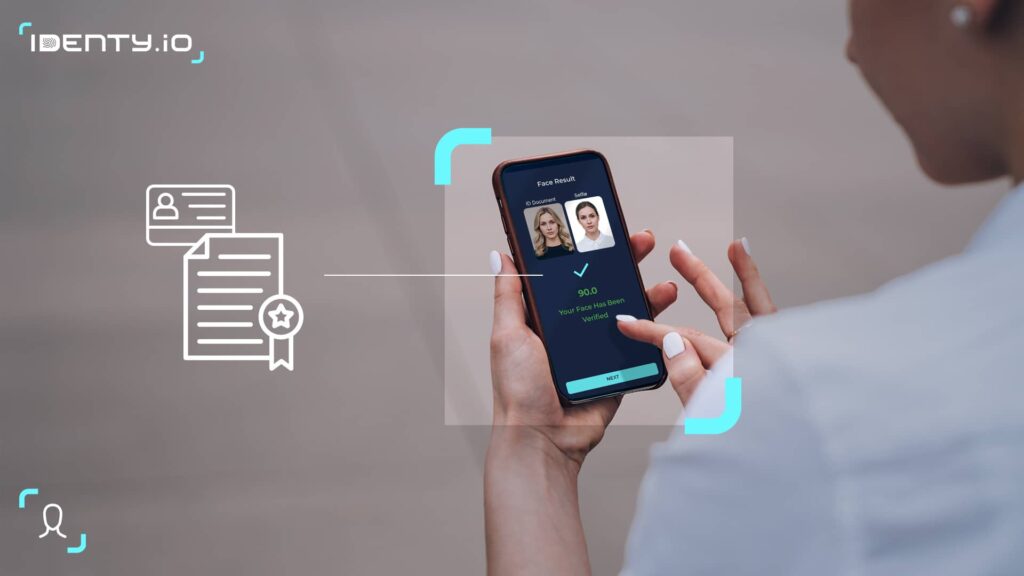
This risk is amplified by emerging threats like AI-driven deepfakes. The World Economic Forum’s Cybercrime Atlas initiative warns that sophisticated deepfake tools now enable criminals to bypass facial verification and KYC processes, undermining digital trust and creating systemic risks for institutions. Likewise, Europe’s cybersecurity agency, ENISA, notes that deepfake presentation and injection attacks have quickly become some of the hardest biometric threats to mitigate. These trends highlight a clear business imperative: organizations must strengthen authentication or face escalating fraud, compliance failures, and reputational damage.
Learn how Identy.io strengthened mobile security in the banking sector with advanced fingerprint biometrics and seamless user experience.
What is FIDO?
FIDO-compliant authentication offers a path to regain security and user confidence. FIDO (Fast IDentity Online) is an open standard that replaces passwords with cryptographic credentials and biometrics. It uses the combination of something the user has (a secure device-bound key) and something the user knows (like a fingerprint, face, or PIN) to verify identity. This approach is inherently phishing-resistant and fraud-proof. There’s no static password to steal or phish, authentication is local and tied to the user’s device. In fact, one of FIDO’s greatest strengths is that it isn’t susceptible to phishing or man-in-the-middle attacks that target user credentials.
An attacker can’t trick a user out of a passkey the way they could a password. To compromise a FIDO login, a fraudster would need to physically obtain the user’s device and somehow replicate their biometric or PIN, an exponentially higher bar than guessing or stealing a password.
This significantly reduces the risk of account hijacking and raises the level of digital trust in each login transaction. FIDO biometrics also bolster trust by protecting privacy. In FIDO implementations, biometric data (such as facial or fingerprint templates) never leaves the user’s device.
Authentication is performed via a cryptographic challenge–response, and only a confirmation is sent to the server, not the biometric itself. This design means users don’t have to worry about their fingerprints or face scans being exposed in a central database breach. It also ensures compliance with strict data regulations. For example, under EU GDPR, biometrics are classified as sensitive personal data and generally cannot be processed or stored off-device without special justification. FIDO aligns perfectly with these requirements: it keeps biometric info local on a user’s phone, transmitting only a yes/no authentication token, thereby meeting privacy mandates by design. Security standards bodies have taken note; FIDO’s approach of local biometric validation meets high-assurance guidelines like NIST SP 800-63 for multi-factor authentication, since the biometric factor remains bound to the device and isn’t shared over the network. By deploying FIDO-compliant biometrics, organizations can enhance security and user privacy concurrently, a foundational element of digital trust.
Integrate secure, on-device biometric authentication and advanced liveness detection into your mobile app with a scalable, enterprise-ready SDK.
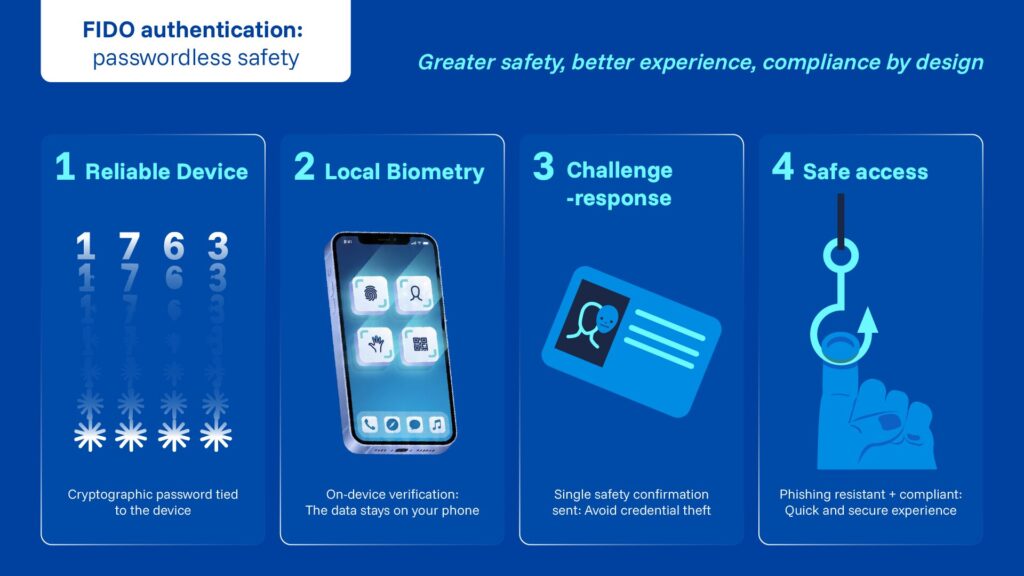
What is FIDO?
How to use FIDO?
Beyond security, FIDO authentication delivers a superior user experience that technology leaders (CMOs, CTOs, Heads of Security) can leverage for competitive advantage. Passwordless, biometric logins are fast and frictionless, a customer can unlock an app with a face scan or fingerprint tap in a split second, instead of laboriously typing passwords or waiting for SMS codes. This convenience directly impacts adoption and engagement. A real-world example comes from a major government agency in Australia that rolled out FIDO-based passkeys to millions of users. The result was striking: up to an 80% user activation rate on mobile within weeks of launch, as citizens embraced the simpler login experience.
This high adoption not only improved user satisfaction but also translated into operational savings, this agency saw a significant drop in authentication support calls and a reduction in one-time password delivery costs.
In the private sector, banks and fintech firms report similar wins. Leading banks like Wells Fargo and HSBC now allow customers to access mobile banking via built-in device biometrics, eliminating passwords and reset calls. This shift aligns with regulations such as PSD2’s Strong Customer Authentication in the EU, which recognizes biometrics as a compliant factor for secure logins. Fintech challengers, too, have capitalized on biometrics for seamless onboarding and payments.
FIDO biometrics not only streamline the customer journey but also build confidence, users feel safer knowing their account is protected by something as unique as their fingerprint or face, rather than a memorized string of characters. Scalability is another critical benefit. As organizations grow their user base into the millions, a FIDO-compliant solution scales gracefully. The FIDO standards are universal and interoperable across devices and platforms. The FIDO Alliance, a coalition of tech companies, banks, government agencies, and security providers, has ensured that FIDO authentication is built into virtually all modern smartphones, laptops, and web browsers.
This means a bank or government agency can enable passwordless login for users on iOS, Android, Windows, and other systems with minimal fuss. There’s no need for proprietary tokens or special reader devices; users leverage the hardware they already own (e.g. their phone’s secure enclave and biometric sensor). By being FIDO compliant, an authentication solution like Identy’s platform (a FIDO Alliance member) adheres to these global standards out-of-the-box.
This interoperability not only future-proofs the deployment but also eases regulatory compliance, many regulators explicitly favor standards-based approaches to security. Organizations can demonstrate that their mobile authentication meets industry best practices and certifications, which is reassuring for auditors and customers alike.
Get a tailored demo of our contactless biometric platform and see how it fits your specific use case.
Navigating the web of security regulations is a top concern for CIOs and digital identity leaders. Implementing FIDO-compliant authentication helps check many compliance boxes in one stroke. Regulations across fintech and government consistently call for strong customer authentication and protection of personal data.
For instance, the European Banking Authority’s guidelines and PSD2 mandate multi-factor authentication for payments, where factors must include something like biometrics or hardware tokens. A FIDO biometric login inherently fulfills this by combining a user’s trusted device (possession factor) with a biometric (inherence factor) in a passwordless flow. It’s a user-friendly way to meet “strong customer authentication” requirements without resorting to clunky methods that hurt conversion rates.
On the data protection side, as discussed, FIDO’s local processing of biometric data addresses GDPR and even emerging AI risk regulations by minimizing sensitive data exposure. In the United States, agencies are encouraged by NIST and OMB guidance to adopt phishing-resistant authenticators for citizen services, FIDO is explicitly cited as a solution that meets high assurance levels for government login use cases. By choosing authentication systems built on FIDO standards, organizations position themselves to comply with not only today’s laws but also tomorrow’s.
The security landscape is evolving (consider how deepfake fraud wasn’t on any regulator’s radar until recently). Open standards like FIDO, backed by an alliance of industry and government experts, tend to adapt faster to new threats than closed, legacy systems. This means adopting FIDO is a strategic bet on staying ahead of evolving security requirements. It’s telling that forward-looking institutions are already on board, from tech giants and banks to government bodies worldwide, signaling that FIDO’s approach is becoming the baseline for trustworthy digital identity.
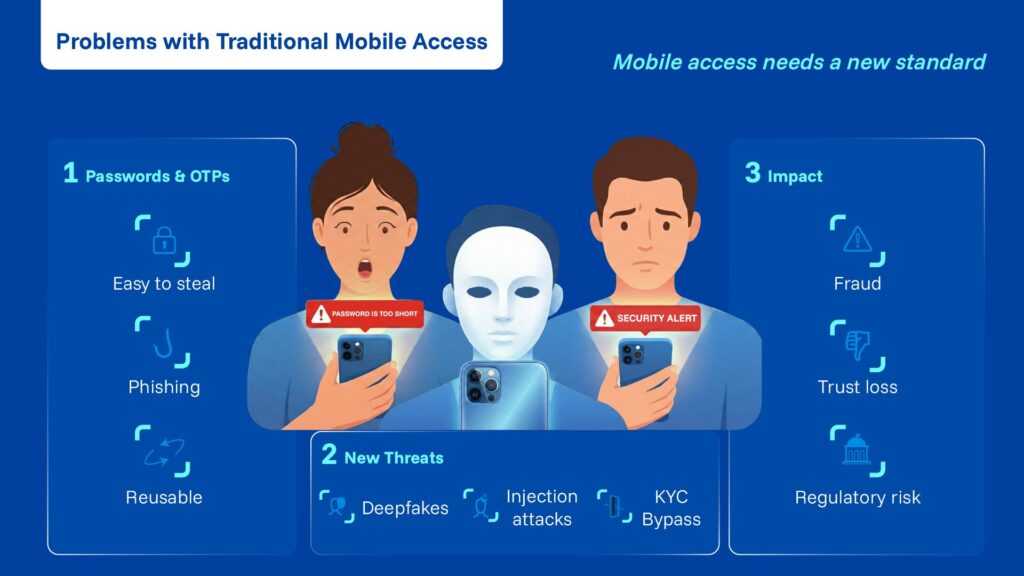
Problems with traditional mobile access
Real-World Impact and Strategic Outlook
FIDO-compliant authentication isn’t just theory; it’s proving its value in the field. We’ve seen government agencies achieve both security and efficiency gains with passkeys, setting a model for public services. In the financial sector, institutions are reporting reductions in fraud and smoother customer interactions after going passwordless. Banco Popular Dominicano, for example, implemented biometric identity verification for high-risk mobile transactions to safeguard customers, a move that reflects wider industry efforts to combat fraud with stronger methods.
Learn how Identy.io strengthened mobile security in the banking sector with advanced fingerprint biometrics and seamless user experience.
By deploying standards-based biometrics, they and others have strengthened digital trust: clients feel confident that their accounts and data are protected by cutting-edge security, which in turn encourages greater use of digital channels. From a strategic perspective, adopting FIDO authentication is more than a security upgrade; it’s a business enabler. It allows organizations to confidently roll out new mobile services (digital banking, e-government apps, fintech innovations) knowing that users can access them securely and conveniently. It also future-proofs the business against emerging threats like deepfakes and credential stuffing, which are on the rise globally. Companies like Identy, as members of the FIDO Alliance, are helping lead this charge by delivering authentication solutions that are FIDO certified and interoperable, so that fintechs, banks, and governments can focus on their core mission rather than the minutiae of authentication tech.
In conclusion, FIDO-compliant authentication marries strong security with elegant user experience, directly addressing the business risks of our digital era. It reduces fraud and regulatory risk by leveraging phishing-proof, privacy-preserving methods. It enhances user satisfaction through seamless logins, which drives adoption of digital services. And it scales to meet both the technological and compliance demands of large enterprises and government programs. For CMOs and CTOs championing digital transformation, FIDO biometrics offer a compelling proposition: a way to build digital trust at scale. Embracing these standards now is a strategic investment in a safer, more user-centric digital future, one where customers and citizens can access mobile services with confidence that their identity is secure.
Bibliography
Fido Alliance: https://fidoalliance.org/company/identy/
NIST, Digital Identity Guidelines (SP 800-63B), Official U.S. guidelines for authentication, recommending phishing-resistant, multi-factor approaches: https://nvlpubs.nist.gov/nistpubs/specialpublications/nist.sp.800-63b.pdf
ENISA, Remote ID Proofing Good Practices (2024), European cybersecurity agency report highlighting deepfake and biometric attack trends, and countermeasure frameworks: https://www.enisa.europa.eu/sites/default/files/2024-11/Remote%20ID%20Proofing%20Good%20Practices_en_0.pdf
World Economic Forum, Unmasking Cybercrime: Strengthening Digital Identity Verification against Deepfakes (2026), WEF Cybercrime Atlas report on how AI deepfakes threaten identity systems, calling for robust biometric authentication and liveness detection: https://reports.weforum.org/docs/WEF_Unmasking_Cybercrime_Strengthening_Digital_Identity_Verification_against_Deepfakes_2026.pdf
Banco Popular Dominicano: Digitalising Dominican finance | World Finance : https://www.worldfinance.com/banking/banco-popular-dominicano-digitalising-dominican-finance