
Table of Contents
ToggleThe rapid digitization of financial, administrative, and telecommunications services in Latin America has accelerated the adoption of biometric verification solutions and advanced biometrics for telecommunications to combat the growing rise of digital fraud and identity theft. In Mexico alone, nearly 16 million people could fall victim to some form of digital fraud by 2026, according to estimates based on data from the National Commission for the Protection and Defense of Financial Services Users (CONDUSEF), while the Federal Telecommunications Institute warns that more than 95.5% of the country’s mobile phone users are exposed to phenomena such as SIM swapping if they do not implement additional security measures beyond authentication via SMS or phone calls.
At the same time, countries such as Peru and Colombia also face significant challenges related to both digital security and technological inclusion: according to data from the Crime and Violence Observatory, more than 2.7 million Peruvians experienced some form of identity theft in 2025, while a study by Accenture reveals that 32% of Peruvian business leaders currently consider identity theft to be their top concern.
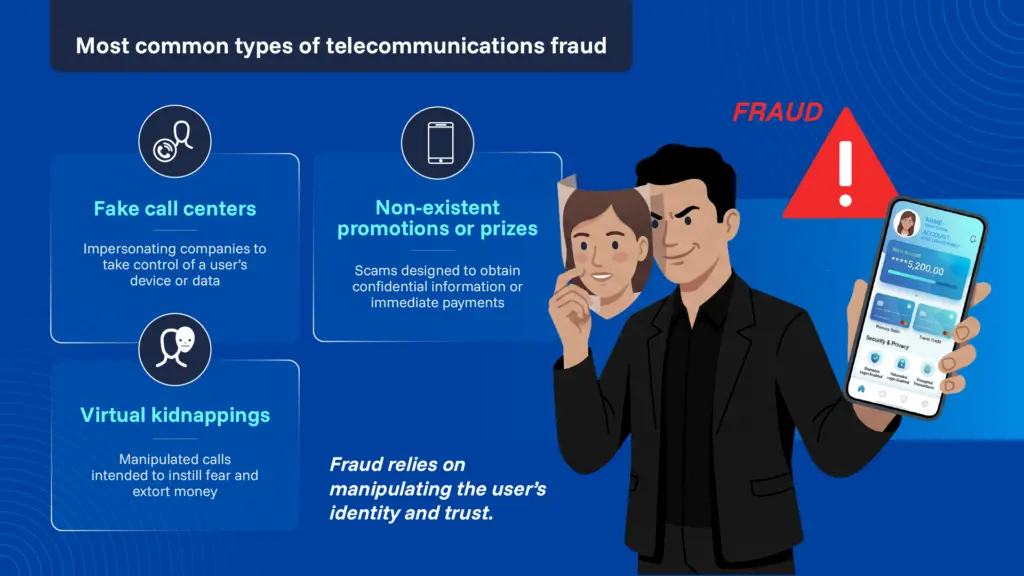
Among the most frequent types of fraud in telecommunications are:
- Fake call centres: Criminals pose as bank or telecommunications company employees to convince victims to install remote access applications, taking full control of the phone and accessing banking apps or personal data.
- Non-existent prizes: Criminals resort to supposed prizes or fake promotions to pressure users into sharing confidential information or making immediate payments.
- Virtual kidnappings: Criminals use calls manipulated with ambient sounds and leaked internet data to generate panic and demand urgent transfers.
These scam methods demonstrate how telecommunications fraud no longer depends solely on technical vulnerabilities, but also on the attackers’ ability to exploit people’s identity and trust.
Biometric verification solutions as a new barrier against telecommunications fraud
The growth of phone scams and identity theft attempts has forced the telecommunications sector to adopt stronger biometric verification solutions and more secure biometrics for telecommunications authentication mechanisms. In an environment where criminals resort to emotional manipulation and the use of artificial intelligence to deceive users, biometrics is establishing itself as one of the most effective tools for protecting both users and organisations. In this case, biometric verification technologies significantly reduce the risks associated with identity theft by ensuring that the person accessing a service, authorising an operation, or requesting a procedure is truly who they say they are.
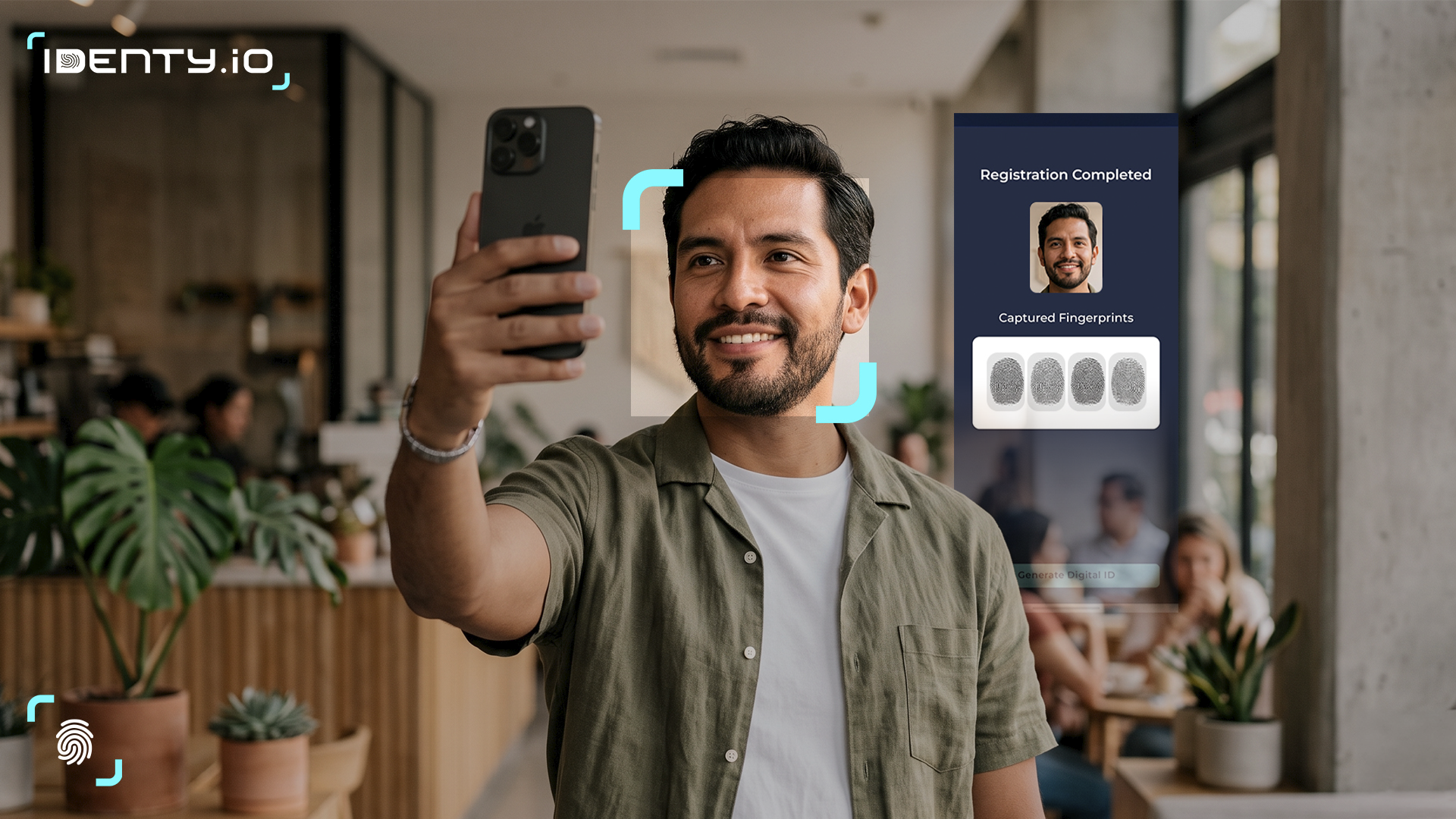
The process begins with digital onboarding, where biometric verification solutions allow users to capture their fingerprints or facial features using their own mobile phone to generate secure digital credentials. From that moment on, these credentials can be used to validate the user’s identity against official databases, allowing for 1:1 and 1:N authentication processes with high levels of reliability. Furthermore, these solutions allow for the issuance of biometric QR codes containing validated user information, which can be used to authenticate or share specific data in a controlled manner, allowing each person to decide what information they share, when, and with whom.
This approach is particularly relevant for biometrics for telecommunications, where many scams occur precisely through fake calls, line change requests, SIM swaps, or fraudulent access to user accounts. Thanks to biometrics, it is possible to add a layer of security that is practically impossible to replicate using traditional methods based solely on passwords, SMS, or security questions, which are often vulnerable to social engineering attacks or data leaks.
Unlike the basic biometric systems integrated into many mobile devices, Identy.io’s biometric verification solutions are not limited to checking that the face or fingerprint matches those previously stored on the phone. The technology compares the user’s biometric information against verified credentials and authorised databases, ensuring the real authenticity of the digital identity and considerably raising the level of protection against sophisticated fraud attempts.
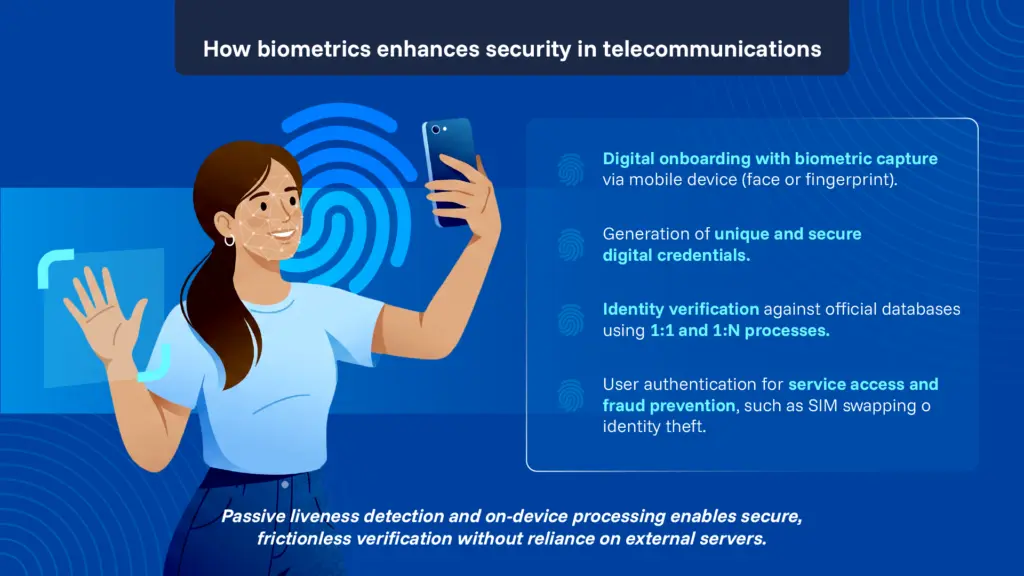
Passive liveness and on-device architecture in biometric verification solutions
One of Identy.io’s differentiating elements is the use of passive liveness detection technology, designed to detect fraud attempts without adding complexity to the user experience. Unlike other systems that require specific movements, such as blinking, smiling, or turning the head, this technology works transparently and automatically, analysing factors such as skin micro-movements, facial patterns, depth, or light reflections to confirm that the person interacting with the system is real and not a photograph, a video, a mask, or an AI-generated deepfake.
This is especially important in the current context, where cybercriminals increasingly use artificial intelligence tools to create synthetic identities or simulate real voices and images with a high degree of precision. Thanks to the use of advanced AI algorithms and proprietary biometric models, these solutions are capable of identifying anomalies imperceptible to the human eye and blocking fraudulent access before it can compromise the security of the user or the telecommunications operator.
Added to this layer of security is a completely on-device architecture, in which all the user’s biometric information is processed and stored directly on the mobile phone itself. This means that sensitive data does not need to be constantly sent to external servers to validate identity, drastically reducing the risks associated with leaks, interceptions, or attacks on centralized databases. Furthermore, this approach eliminates the dependency on a permanent internet connection and allows the solution to work even on low-end devices that only need a camera and a flash to capture biometric information.
In a context where phone scams and identity theft evolve at the same pace as technology, biometrics for telecommunications are becoming essential for protecting users without creating friction in their digital experience. Advanced biometrics, combined with secure architectures and user-centric privacy models, is emerging as one of the most solid responses to this new threat landscape. Through technologies such as passive liveness, digital credentials, and on-device biometric authentication, Identy.io demonstrates how biometric verification solutions can help telecommunications companies build more secure, accessible, and reliable digital ecosystems.