
Table of Contents
ToggleThe best identity verification software is not a brand — it is a set of verifiable properties: independently benchmarked biometric accuracy, certified liveness detection, universal device reach, modality coverage that matches your use case, and a privacy architecture that survives regulatory scrutiny. This guide gives you the evaluation framework, the certification standards to demand, the red flags to avoid and a practical checklist you can take into any vendor conversation. For background on how verification works end to end, see our complete guide to identity verification.
Deepfakes are becoming more sophisticated, increasing the risk of fraud and identity manipulation in digital environments. Download our 10-step guide to learn how to detect threats early and protect your organization with proven best practices.
What the best identity verification software must do
Strip away the marketing and every identity verification solution is judged on four jobs: prove the document is genuine, prove a live person is present, prove the person matches the document, and do all of it fast enough that legitimate users do not abandon. A solution that excels at three and fails one is a liability — fraud enters through the weakest layer, and revenue leaks through the slowest one.
The 6 evaluation criteria that separate solutions
1. Certified liveness detection
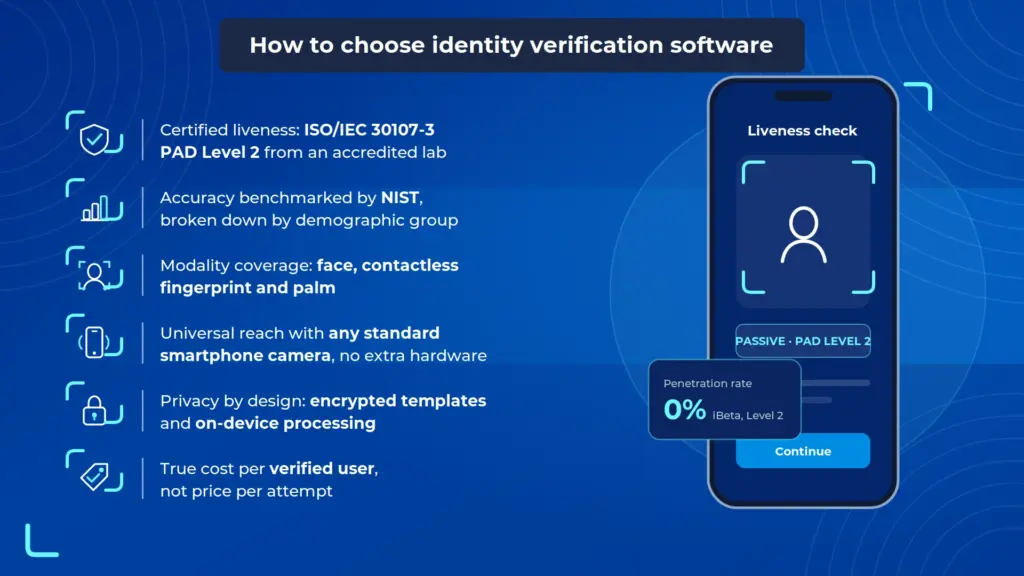
Anti-spoofing claims mean nothing without third-party testing. Demand ISO/IEC 30107-3 PAD Level 2 certification from an accredited lab — the level that covers 3D masks and sophisticated artifacts, not just printed photos. We explain the standard and the attack types in our guide to liveness detection software. Identy’s engine passed Level 2 evaluation with a 0% penetration rate — see the certification details.
2. Independently benchmarked accuracy
Ask where the matching algorithms stand in NIST evaluations or equivalent independent benchmarks, broken down by demographic group. Internal accuracy figures without an external reference are unverifiable.
3. Modality coverage
Face-only solutions exclude the use cases where fingerprints or palms are the enrolled trait — national ID systems, banking cores, workforce deployments. Full coverage means face, contactless fingerprint and palm verification, as delivered by Identy’s biometric identity verification platform.
4. Universal device reach
If verification requires a dedicated sensor, your addressable user base shrinks to the devices that have one. Camera-based capture through the standard smartphone camera reaches 100% of smartphone users — decisive for financial inclusion and government programs.
5. Privacy architecture
Biometric data is a special category under GDPR and equivalent frameworks. Prefer solutions that process on-device where possible, store only encrypted templates (never raw images), and document data flows for your DPO before procurement asks.
6. True cost per verified user
The relevant metric is not price per verification — it is price ÷ pass rate, accounting for retries. A cheaper solution with a 75% first-pass rate costs more per verified customer than a pricier one passing 95% of legitimate users.
Get a tailored demo of our contactless biometric platform and see how it fits your specific use case.
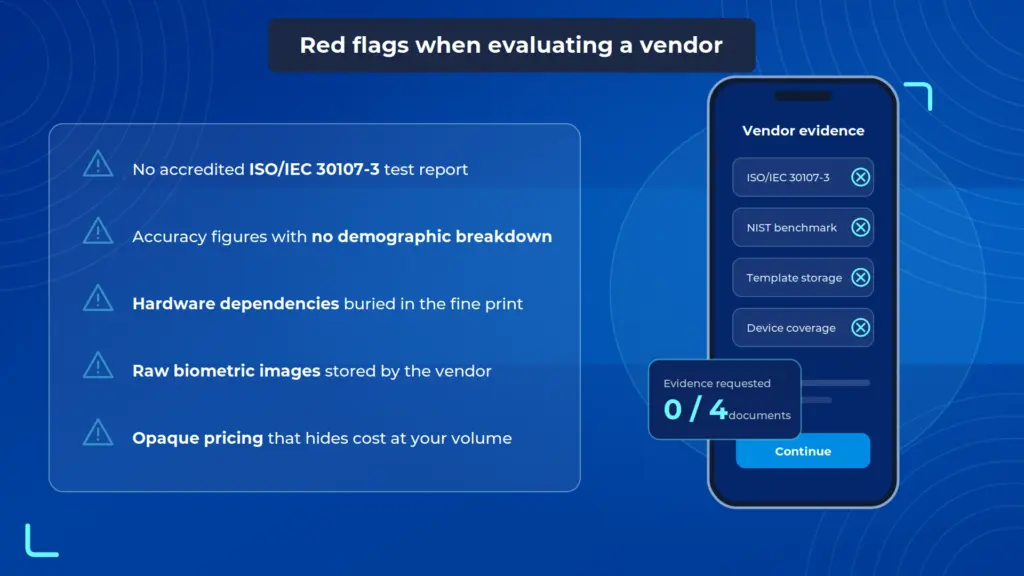
Red flags when evaluating identity verification solutions
- No accredited PAD report. ‘Bank-grade liveness’ with no ISO/IEC 30107-3 evidence is a claim, not a control.
- Accuracy figures without demographic breakdown. Averages hide failure modes that become discrimination complaints.
- Hardware dependencies buried in the fine print. Pilot on the cheapest Android devices your users actually own.
- Raw biometric image storage. If the vendor keeps selfies and fingerprint photos, their breach becomes your breach.
- Opaque pricing tiers. Insist on modeling total cost at your real volume, pass rate and retry distribution.
The Buyer's Checklist
- Request the ISO/IEC 30107-3 Level 2 test report and verify the issuing lab’s accreditation.
- Request NIST or equivalent benchmark positions for every matching algorithm in scope.
- Pilot with your real user base and devices; measure first-pass rate, median completion time and abandonment.
- Run a data-protection review: template storage, on-device options, retention and deletion guarantees.
- Test the SDK integration effort on your actual stack — explore the Identy biometric SDK documentation as a reference for what complete tooling looks like.
- Negotiate on cost per verified user, not cost per attempt.
How Identy measures against these criteria
Identy verifies identity with face, contactless fingerprint and palm biometrics captured by any standard smartphone camera, combined with document verification and passive liveness certified at ISO/IEC 30107-3 PAD Level 2 (0% penetration rate). Templates are encrypted and processing can run on-device, and the SDK ships for native mobile and web. See the id verification software product page for capabilities and a demo request.
Get a tailored demo of our contactless biometric platform and see how it fits your specific use case.
Frequently Asked Questions
What is the best identity verification software?
The one that verifies documents and biometrics with independently benchmarked accuracy, holds ISO/IEC 30107-3 PAD Level 2 liveness certification, works on any smartphone camera without dedicated hardware, covers the modalities your use case requires and keeps biometric data private by design.How much does identity verification software cost?
Typically per verification: from under $0.50 for basic document checks to $2+ for full document-plus-biometric flows with screening. Model the true cost as price per verification x pass rate and retries, not the list price.What features matter most in identity verification solutions?
Certified liveness (ISO/IEC 30107-3 Level 2), independently benchmarked accuracy, document coverage in your markets, SDK quality and device compatibility, privacy architecture, and cost at your volume.
References
- NIST — Face Technology Evaluations (FRTE/FRVT), accuracy benchmarks. https://www.nist.gov/programs-projects/face-technology-evaluations-frtefate
- ISO/IEC 30107-3 — Biometric presentation attack detection, Part 3. https://www.iso.org/standard/79520.html
- iBeta — PAD testing levels and accredited evaluation. https://www.ibeta.com
- FATF (2020) — Guidance on Digital Identity (remote onboarding assurance). https://www.fatf-gafi.org/
- EDPB / GDPR Art. 9 — Processing of special categories of personal data (biometric data). https://gdpr-info.eu/art-9-gdpr/