


Fingerprint Biometric SDK
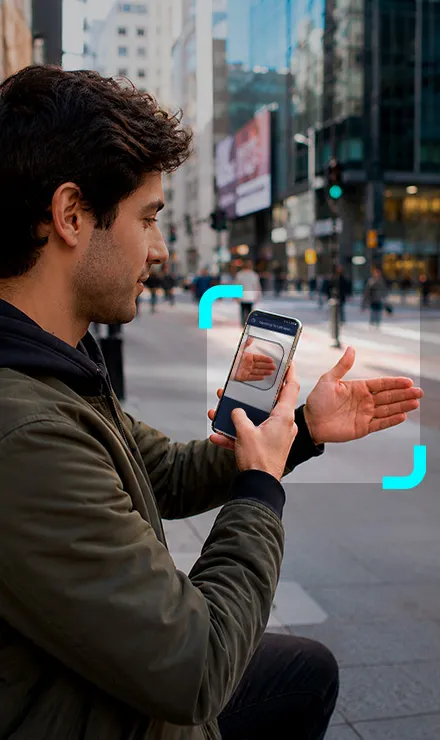
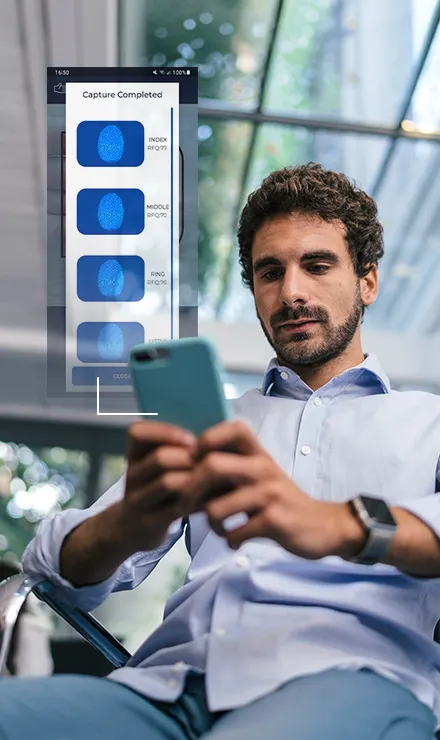
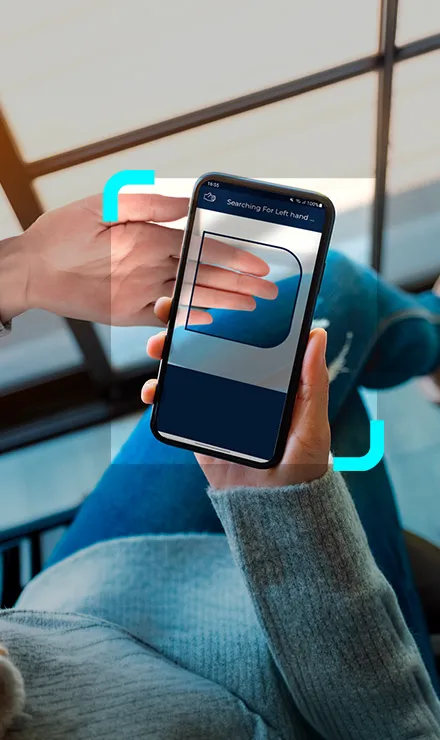
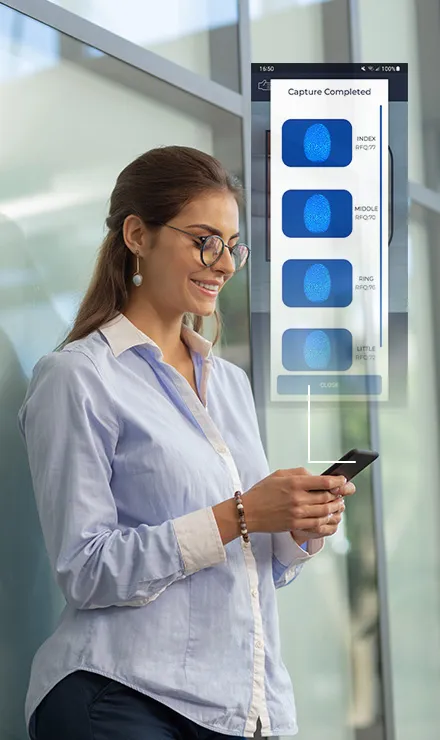
Eliminate dependency on costly biometric hardware and bring high-precision fingerprint capture to any smartphone. The touchless Fingerprint SDK transforms standard mobile devices into secure, scalable biometric enrollment and authentication tools—using only a >5MP rear camera with flash, fully compatible with Android 6+ and iOS 13+.
For CTOs managing legacy biometric infrastructures or large-scale identity programs, this means one thing: no more hardware bottlenecks. Deploy faster, scale globally, and maintain compliance with existing standards—without sacrificing accuracy or security.
As part of a multi-modal biometric platform, this SDK integrates seamlessly with facial and palm recognition, while supporting anti-spoofing and liveness detection and integrates with Identy.io’s ABIS for large-scale identification.
Fingerprint Biometrics: Turn Cameras into Scanners
Traditional fingerprint systems are constrained by specialized hardware—expensive to procure, complex to distribute, and difficult to maintain at scale. The Touchless Fingerprint SDK removes these barriers entirely.
By leveraging advanced computer vision and texture analysis, the SDK captures high-quality fingerprint data through the smartphone camera, enabling:
- 1:1 authentication for secure login and identity verification
- 1:N identification across large-scale databases
- Global scalability without physical device logistics
No scanners. No shipping. No field maintenance.
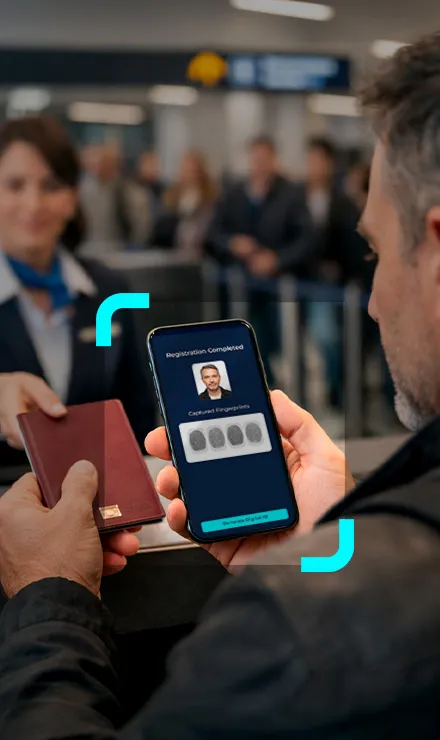
This approach is particularly valuable in environments where deploying hardware is impractical—remote regions, large government rollouts, or distributed financial services. With only a mobile device, users can enroll and authenticate seamlessly, reducing friction while dramatically lowering operational costs.
Additionally, the capture process can be reinforced with liveness detection (Finger SDK has passive, single-capture, on-device liveness. Compliant with ISO 30107-3) and anti-spoofing mechanisms, ensuring that fingerprint data originates from a real user and not synthetic or injected sources.
The result: a fully software-driven biometric layer that aligns with modern digital identity strategies.
NIST CRADA standards & exportable templates
One of the biggest challenges in modernizing biometric systems is compatibility with existing infrastructure. The Touchless Fingerprint SDK is built with this reality in mind.
It generates fingerprint templates compliant with NIST standards. NISTIR 8315, the published output of the NIST CRADA contactless fingerprint interoperability program, where Identy.io was rated the most interoperable touchless mobile application. That’s including compatibility with widely used formats such as NFIQ scoring and CRADA guidelines, ensuring seamless integration with:
- National ID systems
- Law enforcement databases
- Banking and telecom KYC infrastructures
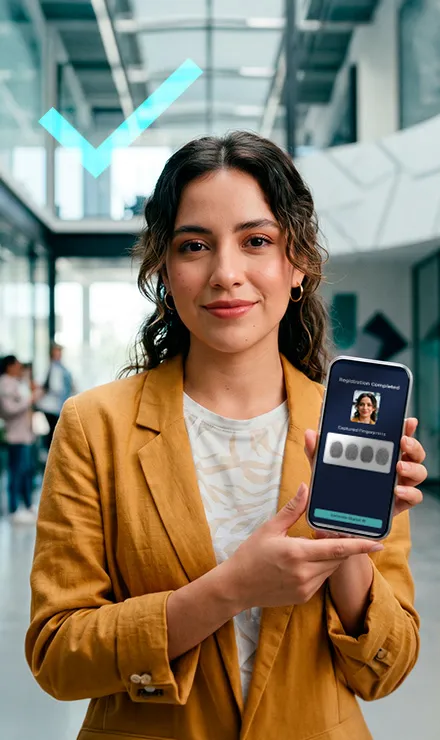
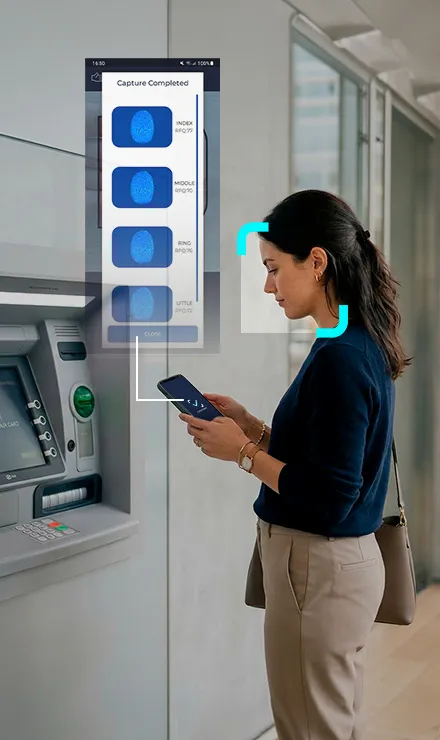
Captured fingerprints can be exported as standardized templates as PNG, RAW, ANSI NIST 2007, ISO 19794-4, ISO/IEC 19794-2, WSQ, JSON” with “500 dpi / 8-bit, 256 grayscale” resolution and WSQ compression ratios (5:1, 10:1, 15:1, 20:1), allowing organizations to extend the life of existing databases while upgrading the capture layer.
When combined with an ABIS layer, these templates can be used for large-scale identification, deduplication, and identity verification across millions of records—without requiring a redesign of your existing systems.
This means you don’t need to rebuild your backend systems. Instead, you enhance them—introducing touchless capture while maintaining full interoperability with legacy matching engines.
For CTOs, this reduces migration risk and accelerates time-to-value.
Root-of-Trust Security: Android KeyStore & iOS Keychain Integration
Security is not an afterthought—it is foundational. The touchless Fingerprint SDK integrates directly with the secure enclaves of mobile operating systems, leveraging:
- Android KeyStore for hardware-backed key management
- iOS Keychain for encrypted biometric storage
Biometric templates are processed and stored securely on-device, ensuring:
- Protection against data exfiltration
- Compliance with privacy-by-design principles
- Reduced attack surface compared to server-side systems
This architecture is particularly critical in high-risk environments where biometric spoofing, interception, or database breaches are real concerns.
Combined with on-device anti-spoofing and anti-deepfake detection layers, the SDK ensures that only genuine biometric inputs are processed—protecting against emerging threats such as synthetic identities and injection attacks.
By anchoring trust at the device level, the SDK ensures that sensitive biometric data never leaves the user’s control unless explicitly required by the system architecture.
Built for scale. Designed for reality
Modern identity systems demand flexibility, scalability, and resilience. The touchless Fingerprint SDK delivers on all three:
- Works offline or in low-connectivity environments
- Scales capture to any number of devices without additional infrastructure, with ABIS integration available for identification across millions of records
- Reduces total cost of ownership (TCO) by eliminating hardware and maintenance
Within a multi-modal biometric architecture, fingerprint recognition provides a widely adopted and interoperable layer that can be combined with facial and palm modalities to increase overall system robustness and coverage.
When extended with ABIS and advanced fraud detection capabilities, the platform supports both verification (1:1) and identification (1:N) at scale—across diverse environments and user conditions.
Move beyond hardware. Deploy biometrics at software speed.
The shift from hardware-dependent biometrics to software-driven solutions is not just a technical upgrade—it’s a strategic advantage.
With the touchless fingerprint SDK, you can:
- Accelerate deployment cycles
- Reduce operational complexity
- Maintain compliance with global standards
- Deliver seamless user experiences at scale
As part of a broader multi-modal biometric platform with integrated anti-deepfake protection and compatible with Identy.io ABIS for orchestrated identification workflows, this SDK enables you to build a future-proof identity stack—ready to adapt to evolving threats and global scale requirements.
Certified security. Tested by indendepent labs.
The Finger SDK’s anti-spoofing layer has been independently validated under ISO/IEC 30107-3 — the international standard for presentation attack detection — at both Level 1 and Level 2 by IDIAP Research Institute, a FIDO-certified biometric testing lab with over two decades of PAD research experience.
The result: 0% false accept and 0% false reject at both levels. No spoofing attempts passed. None were incorrectly rejected.
Complementing that, the SDK carries FIDO UAF Level 1 certification on both Android and iOS — confirming that the entire authentication flow meets FIDO Alliance interoperability requirements, not just the capture layer.
For deployments where security evidence needs to go beyond vendor claims, these certifications provide independently auditable proof.
Standards compliance and NIST benchmarks
Templates generated by Finger SDK comply with ISO/IEC 19794-2 (finger minutiae) and ISO/IEC 19794-4 (finger image data interchange) — the two ISO standards that underpin interoperability across national ID systems, AFIS databases, and KYC infrastructures worldwide.
Output formats include PNG, RAW, WSQ, ANSI NIST 2007, and JSON at 500 dpi / 8-bit resolution, with NFIQ 1 and NFIQ 2 quality scores returned on-device per captured finger.
On the NIST side, the picture is equally concrete. The Finger SDK’s template generator (tid+0006) achieved NIST MINEX III compliance in June 2025, demonstrating interoperability with 34 certified MINEX III matchers from independent vendors.
And under the NIST CRADA contactless fingerprint interoperability program — published as NISTIR 8315 — Identy.io (participant D6) was rated the most interoperable touchless mobile application among all mobile participants for matching against legacy contact-based databases.
Finger SDK also participates in NIST PFT III, the U.S. government’s primary ongoing benchmark for fingerprint matching accuracy across law enforcement datasets. Results are publicly available at https://pages.nist.gov/pft/.