

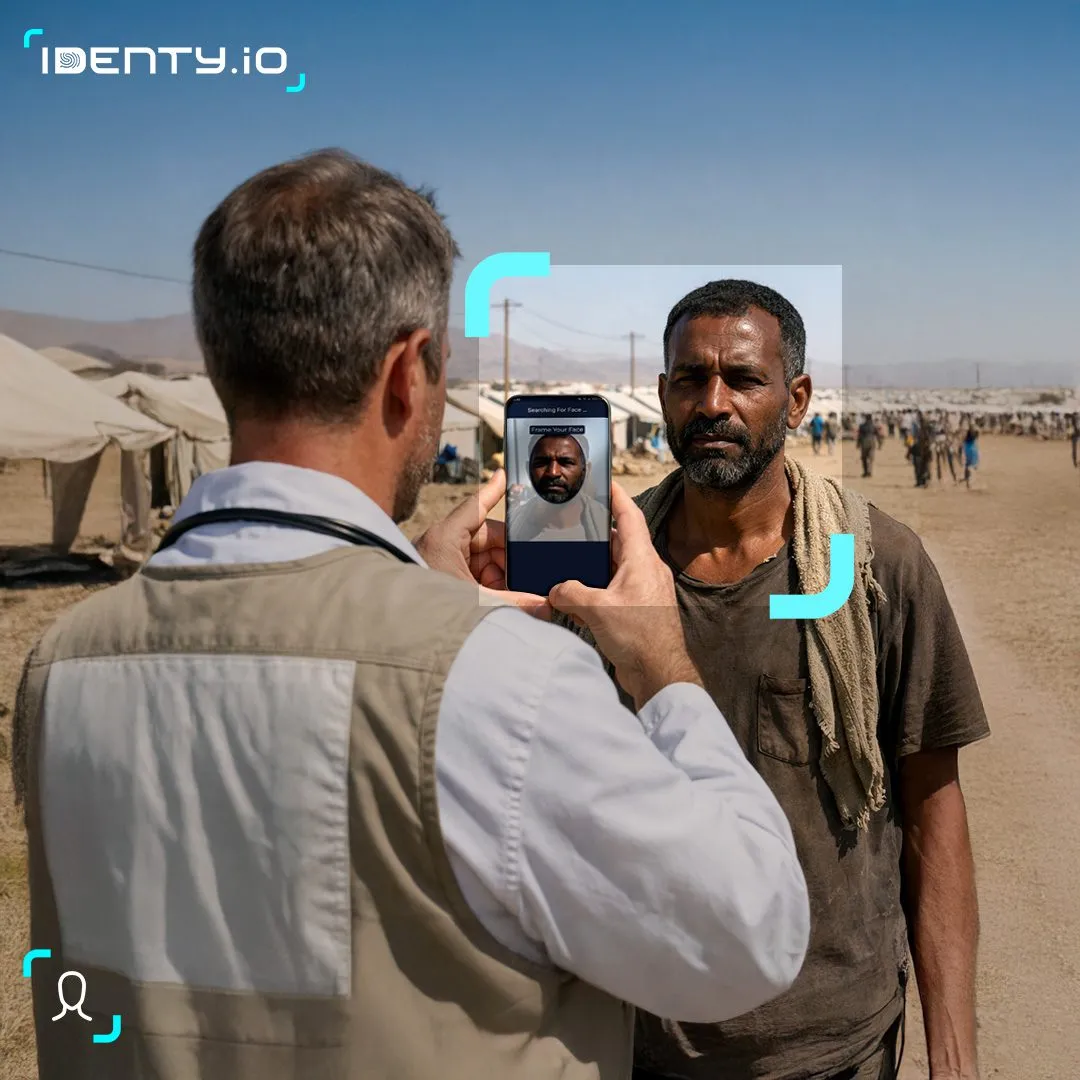
HumanCoop focuses its activity in northern Mauritania, with a team made up of health professionals and other technical experts who offer primary and specialised care services through missions in the area, benefiting a population of over 2,500 people.
According to UNHCR, more than 350,000 people in North Africa and the Middle East still lack an identity or nationality. This makes it impossible to issue any type of document certifying who they are and, consequently, to create medical records that allow their treatments to be tracked.
Identy.io will provide HumanCoop with its facial biometrics identity verification solutions to facilitate the unique identification of each patient, even without documentation. This will speed up access to their medical history and reduce duplicate records for undocumented patients.
Identy.io’s technology operates entirely offline and processes biometric data on the device itself, without the need for an internet connection or cloud storage—an essential requirement for operating in remote areas of the Sahara Desert and ensuring the privacy of vulnerable populations.
Identy.io, a company specialising in identity verification through contactless mobile biometrics and the creation of digital credentials, and HumanCoop, a non-governmental organisation formed by volunteers offering primary and specialised care in North Africa, have reached a humanitarian collaboration agreement. The goal is to facilitate the digitisation of undocumented patients’ identities in the region and create medical records and care logs that allow for better control of their treatments and the progression of their ailments and chronic diseases.
Thanks to this agreement, Identy.io will grant HumanCoop the use of its facial biometrics identity verification solutions on the ground. This will enable the organisation to uniquely identify each patient, even those without a formal identity—whether documented or not—nationality, or previous medical history. This makes it possible to create more accurate and useful medical records during each mission, while helping to reduce duplicate records for patients who often attend consultations without the documentation provided during previous visits, leading to the creation of a new file.
In the first phase of implementation, HumanCoop will begin using Identy.io’s solutions in Bir Mogrein (Mauritania), where an initial user registration will be carried out during two missions. The aim is to create an initial biometric patient database and ensure correct integration with their clinical record system. This will be followed by a progressive expansion of the technology to other areas where they operate (for example, in Zouerate, where they perform surgical procedures), and comprehensive training for the local team and volunteers on using the new biometric identity verification tools. Continuous evaluation processes will also be implemented to identify and measure improvements in identification, consultation times, and case follow-ups.
According to the United Nations High Commissioner for Refugees (UNHCR), North Africa and the Middle East continue to be among the areas with the highest concentration of displaced persons and people without an identity or nationality. As a result, more than 350,000 people have no access to any type of document certifying their identity, which in turn is a serious obstacle to creating any medical history that allows for the monitoring or traceability of their treatments.
HumanCoop, an international cooperation organisation founded in 2020, focuses its activities in northern Mauritania, particularly in the Tiris Zemmour regions, with a primary focus on Bir Mogrein and occasional support in Zouerate during surgical missions. With a team of volunteer health and technical professionals, the organisation provides healthcare support to a population of over 2,500 people in Bir Mogrein, handling between 600 and 1,200 consultations per mission. In Zouerate, they carry out surgical missions for dozens of patients.
For its part, Identy.io works worldwide to help reduce identity theft and spoofing through its advanced contactless biometric solutions. These use mobile phone cameras and flashes to capture a user’s digital credentials—namely their facial features or fingerprints—processing and storing this information on the user’s own device. This protects critical information from potential attacks or data theft in the cloud. Identy.io already works with other social entities, providing them with its biometric solutions; these include The Exodus Road for the prevention of human trafficking, and My Family ID, the only mobile app that allows the capture of digital credentials for the elderly and minors so they can be made available to authorities in the event of a disappearance or kidnapping.
According to Jesús Aragón, CEO of Identy.io: “We believe that biometrics is becoming established as a global security standard, allowing for collaboration on truly important causes beyond fraud prevention or identity theft. Being able to collaborate with entities like HumanCoop gives meaning to our efforts to develop technological solutions that help disadvantaged communities. We are proud to play our part in improving the living conditions of thousands of people in North Africa, and we thank HumanCoop for their trust in our company”.
Ignacio Calatayud, President of HumanCoop, adds: “In our organisation, we have always believed that people are what matter most. Since our inception, all our efforts have focused on reaching those who are overlooked and using our medical knowledge and experience to improve health conditions in disadvantaged communities in the Maghreb. Now, thanks to the collaboration with Identy.io, we can make our work much more efficient and ensure access to treatments better tailored to each patient’s needs based on their history. In this way, we hope to contribute to growing trust in the healthcare system and offer better care, more follow-up, and ultimately, a more protected community”.