

Table of Contents
ToggleFingerprint biometrics identify people by the unique patterns of ridges and minutiae on their fingers. When a fingerprint is scanned, software converts the ridges and valleys into a digital image and then extracts distinctive features (minutiae) to form a biometric template. Later, a new fingerprint sample is compared against this template: a “1:1” match (verification) confirms identity, while a “1:N” match (identification) searches a database. The system’s accuracy is often measured by its false-accept and false-reject rates. In practice, fingerprint matching is extremely reliable because no two fingerprints are alike, making this one of the most mature biometric technologies.
Hardware integration and SDKs
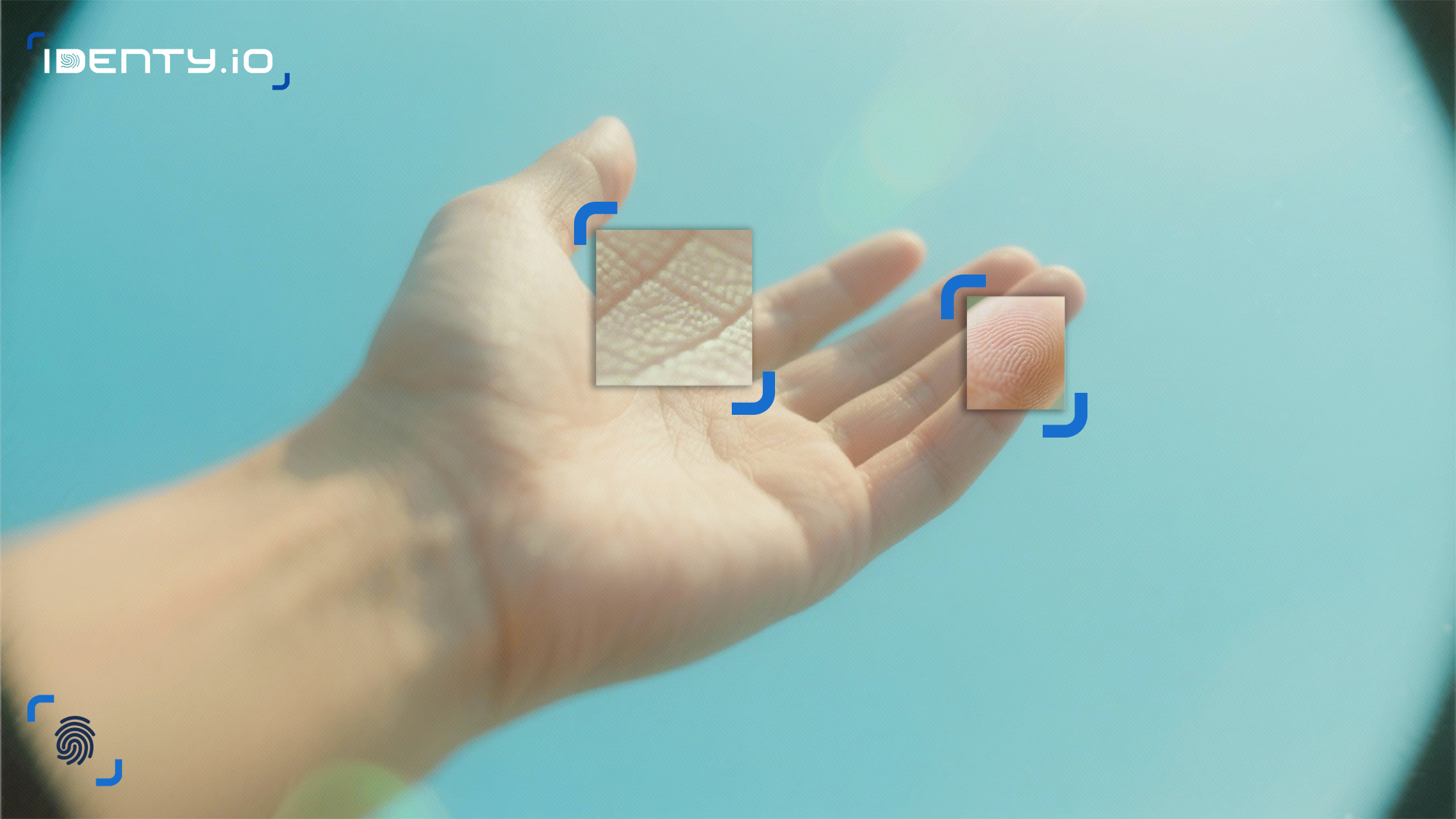
Fingerprint data can come from dedicated scanners or even a smartphone. Optical sensors use LED lighting and a camera (CCD/CMOS) to image the finger when it rests on glass, while capacitive sensors use an electric charge grid under the glass to sense ridges and valleys. Many laptops and phones today have built-in capacitive readers; some Android/iOS devices support external scanners via USB/Bluetooth. Newer “touchless” methods use a smartphone camera with flash: for example, Identy.io’s biometric SDK tools captures a fingerprint image using the phone’s camera and processes it entirely on-device.
To integrate fingerprint hardware into an app, developers usually use a Fingerprint SDK or API. These toolkits provide functions to initialize the scanner, grab an image, and extract minutiae points. For example, a typical SDK might offer methods like openDevice(), captureImage(), and getMinutiae(). The SDK handles sensor drivers and image preprocessing, returning a set of feature points or a standardized template format. Developers then send this template to a matching engine or server. Choosing an SDK often depends on the sensor model and platform (Windows, Android, iOS) and ensures compatibility with your sensor’s communication interface (USB, SPI, etc.).
Key considerations: Hardware must meet regulatory standards for image resolution (often 500dpi for fingerprints) and have proper drivers or middleware. Many SDKs support ANSI/NIST or ISO template formats for interoperability. It’s also common to use multi-finger scanners (capturing two or four fingers) for higher reliability. In all cases, ensure the SDK offers both enrollment (template creation) and authentication (template matching) functions.
Image quality and matching
Image quality is crucial for accurate fingerprint recognition. A blurry, partial, or smudged scan can cause false rejections. NIST has even developed the NFIQ (NIST Fingerprint Image Quality) metric: it scores images from 1 (best) to 5 (worst), and higher-quality images yield significantly better match performance. In practice, capture SDKs often include real-time feedback (like a quality bar or instructions) to help users position their finger correctly and get a clear image. Good lighting, clean sensor glass, and dry fingers improve results.
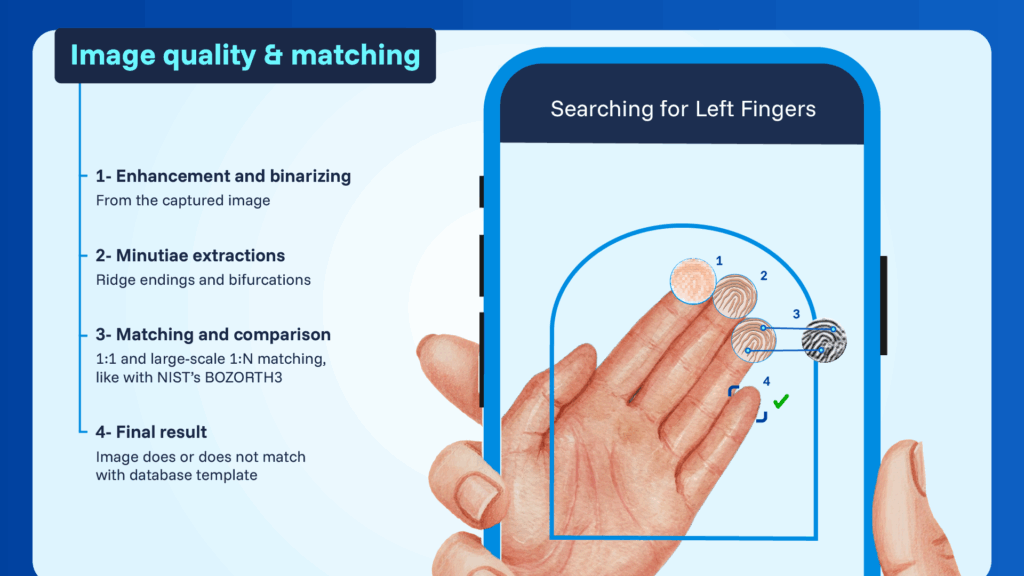
Once a fingerprint image is captured, matching engines perform feature extraction and comparison. The engine first enhances and binarizes the image, then extracts minutiae (ridge endings and bifurcations) into a template. Matching algorithms (often minutiae-based) then compare this template against stored templates. High-performance engines like NIST’s open-source BOZORTH3 can do both 1:1 and large-scale 1:N matching. Systems typically use score thresholds to decide a match. In verification (1:1), you check if the similarity score exceeds a threshold. In identification (1:N), you find the best match and see if it is good enough.
- Quality tools: Implement standards like FBI’s WSQ image compression or use NFIQ to gauge quality. Reject scans below a quality cutoff.
- Matching modes: Decide if you need 1:1 (fast verification) or 1:N (database search). Many solutions support both modes.
- Security: To prevent spoofing, consider liveness detection (e.g. checking blood flow on fingertip) if available. Always encrypt fingerprint templates both in transit and at rest. Identy.io, for instance, keeps processing on-device and never sends raw images to a server.
- Standards: Follow ISO/IEC 19794-2 (fingerprint data format) if integrating with external systems. Many SDKs can output ISO or ANSI/NIST templates.
Privacy, compliance, and regulations
Fingerprint data is legally sensitive. In the US, California’s laws explicitly include fingerprint patterns and biometric identifiers as protected data. The CCPA/CPRA classifies “fingerprints” and “biometric information processed to identify a consumer” as personal data with special protections. Other states (e.g. Illinois under BIPA) require consent before collecting fingerprints and impose strict data security obligations.
Internationally, privacy laws generally treat biometric data like other sensitive personal data. The EU’s GDPR lists biometric data used for ID as a special category requiring explicit consent. Latin American countries are enacting GDPR-like laws. For example, Brazil’s LGPD explicitly lists “biometric data” as sensitive personal data. (Other countries in LATAM – Mexico, Chile, Argentina, etc. – have also updated laws in recent years to align with GDPR protections.) In practice, compliance means you must obtain clear user consent, explain why you collect fingerprints, store data securely (often requiring encryption), and honor data subject rights (access, deletion). Data residency rules may also apply in some regions.
In summary, any fingerprint ID authentication software must be designed with privacy in mind: encrypt templates, keep processing local if possible, and ensure transparency about the data you collect. Industry players like Identy.io emphasize on-device processing to minimize regulatory risk.
We are leaders in fingerprint biometrics
Identy.io is recognized as a leader in mobile fingerprint capture. Its software uses a phone’s camera and flash to capture a fingerprint image without touching a scanner. In 2025 we announced NIST validation of its fingerprint matcher, placing it among the top vendors in the US. Organizations looking for a fingerprint solution can consider Identy’s SDK suite, which supports on-device matching and is built to meet GDPR, CCPA, and other compliance standards.
References
- California DOJ – CCPA FAQ
- DLA Piper – Data protection laws in Brazil
- NIST – Biometric Image Software (NBIS)
- M2SYS – Fingerprint SDK overview
- Identy.io – Newsroom: NIST validation press release