

Table of Contents
ToggleSheriffs occupy a unique position within U.S. law enforcement. As elected officials, they are directly accountable to their communities, balancing public trust with operational effectiveness every day.
The responsibility to protect communities is reflected by a strong interest in technologies that modernize operations, improve accuracy and reduce friction in the field.
The single tool that’s supporting all these efforts simultaneously? Contactless fingerprinting technology.
Mobile-First Biometrics
For decades, fingerprint identification has been one of the most trusted biometric tools used by law enforcement. Yet, traditional workflows still depend heavily on specialized hardware, such as station-based systems, which can significantly delay processes.
Contactless fingerprinting represents a fundamental shift away from the hardware model, offering increased flexibility and efficiency.
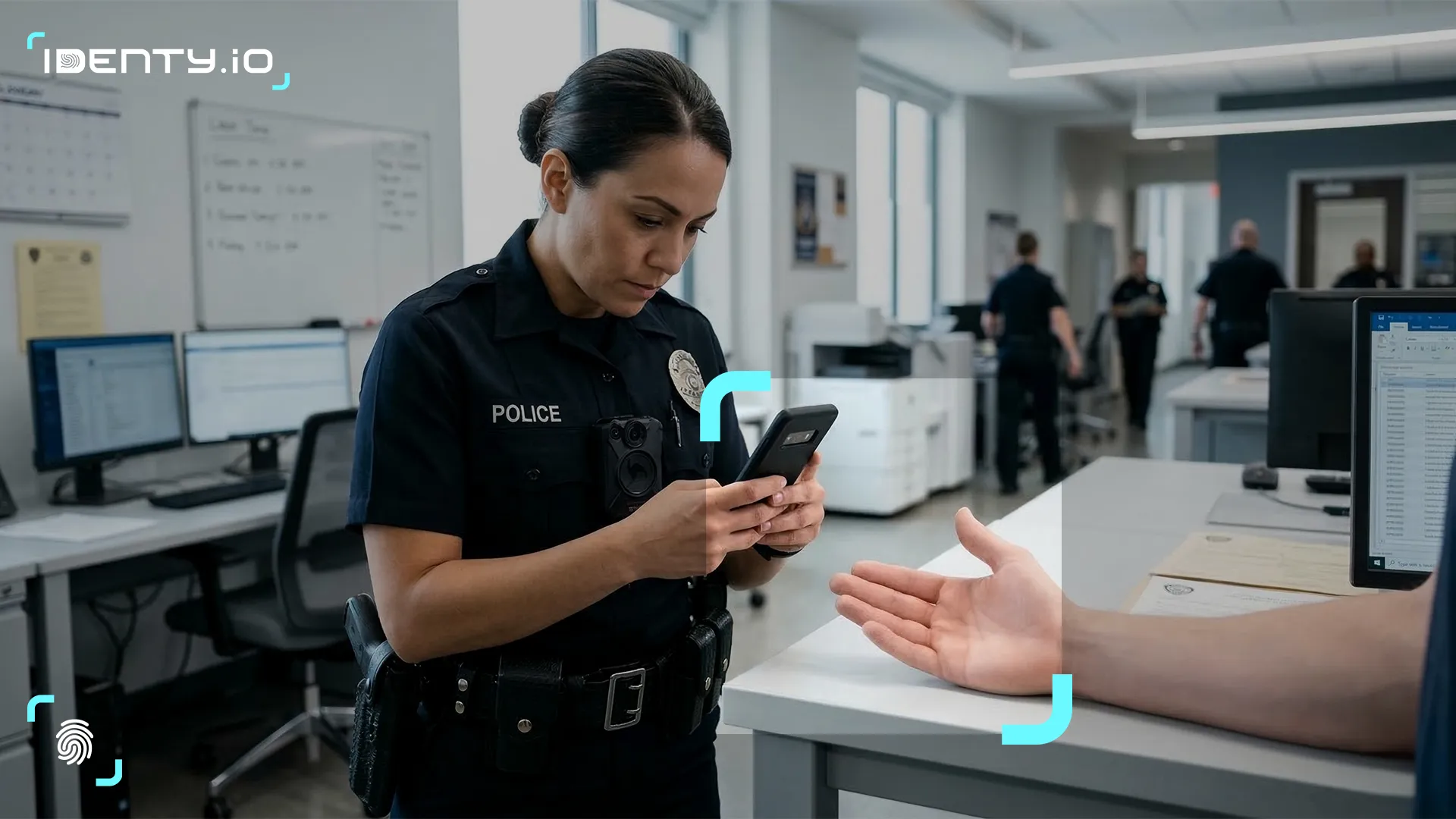
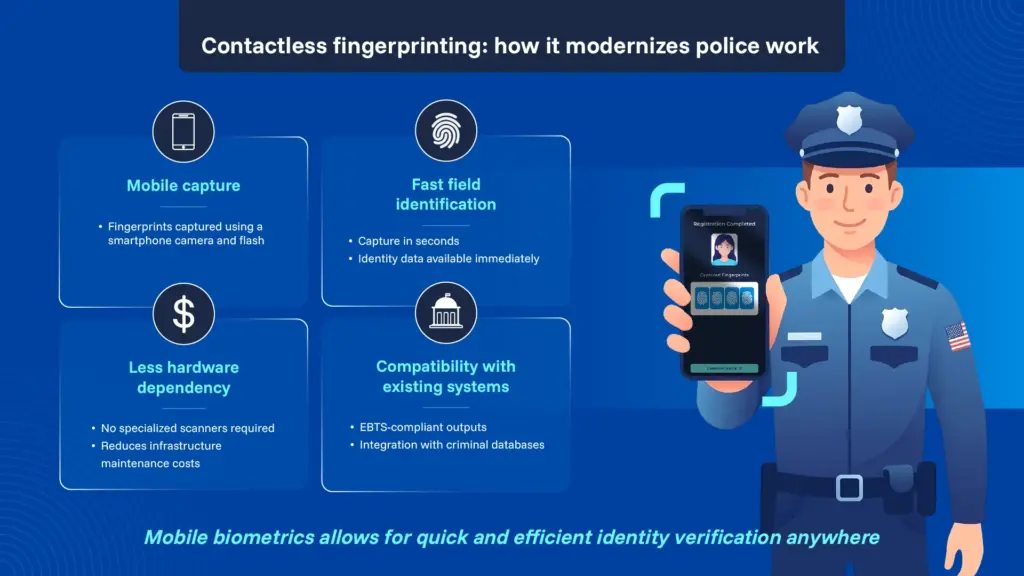
Identy’s touchless fingerprint technology enables officers to capture clear, high-quality fingerprint images with a standard smartphone camera and LED flash. The native software development kit (SDK) enables easy integration of biometric fingerprint authentication into any smartphone’s mobile apps.
By eliminating reliance on physical infrastructure, officers can authenticate identities while maintaining compatibility with major criminal justice databases through EBTS-compliant outputs and significantly reducing hardware maintenance costs.
Because of these benefits of contactless fingerprinting, Identy has seen consistent interest from sheriffs and deputies across the United States.
The simplicity of capturing fingerprints in seconds and generating actionable identity data immediately resonates with those seeking practical, modernized solutions for their agencies.
NIST Validated Contactless Fingerprinting
For law enforcement, identity verification is a critical capability that supports officer safety, investigative efficiency and informed decision-making in the field. Because of this, independent validation plays a critical role in determining that these solutions improve efficiency while delivering accuracy, reliability and interoperability with their workflows.
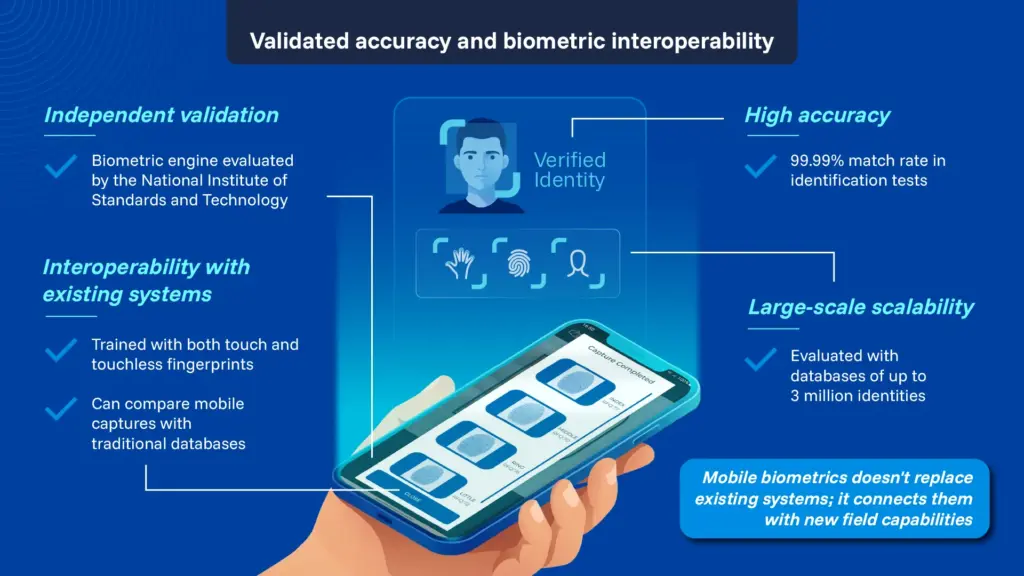
Identy’s fingerprint matching engine has been independently validated by the National Institute of Standards and Technology (NIST) through its Proprietary Fingerprint Template evaluation (PFT III) — one of the most rigorous benchmarks for 1:1 fingerprint verification accuracy. What makes this result particularly relevant for law enforcement is what the test revealed about interoperability.
Identy’s matcher was trained on both touch and touchless fingerprint data, meaning it can match mobile-captured prints against existing touch-based databases without re-encoding or additional hardware. This capability bridges the gap between legacy Automated Fingerprint Identification Systems (AFIS) infrastructure and modern mobile field deployments.
At the identification scale, Identy’s algorithm has been evaluated by NIST through the FRIF TE E1N benchmark, which tests fingerprint identification engines against databases of up to 3 million subjects, on a scale comparable to national border control and large-scale identity programs.
On its first-ever submission, Identy placed in the global top three, achieving a 99.99% match rate in the 4-4-2 identification flat configuration used at border crossings worldwide. Results are publicly verifiable here: pages.nist.gov/frifte/e1n/results/identy+0001/
The convergence of certified accuracy and contactless capture represents a significant step toward equipping public safety officers with the tools they need to modernize and transform their operations while preserving trust.
With the transition from hardware-dependent to software-driven identity already underway, agencies that move early will be better positioned for what comes next.
The future of identity verification relies on software-driven solutions that capture high-quality data on-device for a secure, scalable experience that keeps officers and their communities safe.
As digital identity continues to expand across public safety, mobility and interoperability are becoming defining requirements. The next evolution of biometrics is about more than just better identification—it’s about delivering trusted digital identity when and where it’s needed most.