

Table of Contents
ToggleFingerprint biometrics rely on capturing a person’s unique fingerprint ridge patterns for identity verification. This method is highly reliable and widely trusted. In fact, NIST’s testing found top fingerprint-matching algorithms achieved about 98.6% accuracy with a single finger and ~99.9% with four or more fingers. In practice, adding more fingers greatly boosts overall precision. These figures show why fingerprints are a robust identity factor: the more finger data used, the higher the matching accuracy.
Evaluating matching accuracy
When we implement fingerprint systems, we focus on two key metrics: false-accept rate (FAR) and false-reject rate (FRR). FAR measures how often an impostor is wrongly matched, while FRR measures how often a legitimate user is incorrectly denied. Leading systems operate at extremely low FARs (around 0.01% in NIST’s tests), meaning impostors almost never get through. We tune our algorithms to achieve similarly low error rates in practice. We continuously fine-tune our matcher with real-world data and testing to keep FRR minimal, so authorized users are rarely rejected. The result is a fingerprint solution that is both secure (few false accepts) and user-friendly (few false rejects).
Advances in fingerprint capture
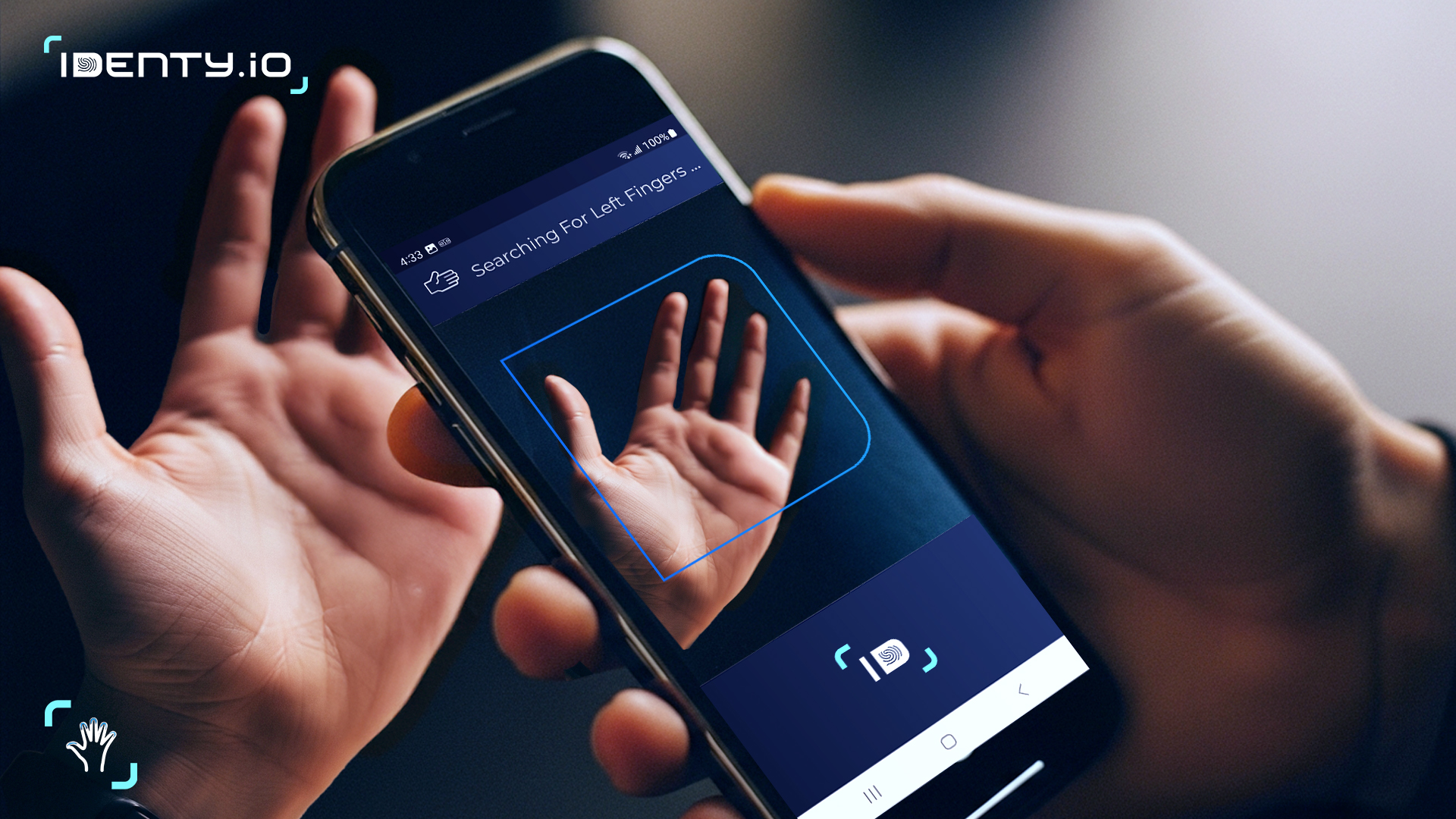
Fingerprint scanning hardware and software have advanced rapidly. Traditional touch scanners remain very accurate, but contactless capture via cameras (for example, using a smartphone) has improved dramatically. NIST reports show that a single-finger contactless scan reached only about 60–70% accuracy, whereas capturing multiple fingers in one shot raised accuracy above 90–95%. In other words, multi-finger contactless capture can nearly match contact scanners. Industry experts now confirm that mobile fingerprint apps rival dedicated readers. These innovations mean developers can deploy accurate fingerprint enrollment and verification using just a mobile device, without extra hardware.
Identy.io’s mobile fingerprint solution
At Identy.io we leverage these advances in everyday devices. Our finger biometric SDK uses an ordinary smartphone’s rear camera (minimum 5 MP with flash) to image all ten fingerprints at once. The entire matching pipeline runs on the device itself: the app acquires the fingerprint images, checks quality, extracts features, and creates fingerprint templates. We compensate for different lighting through adaptive exposure and include real-time liveness detection on each finger so that only a real, live finger will be accepted. Because everything is processed locally (no internet needed), deployment is simple and user privacy is preserved.
We also integrate security and standards into our design. Each fingerprint is checked for liveness to defend against spoof attacks (such as fake molds), addressing known vulnerabilities of fingerprint biometrics. The SDK outputs fingerprint templates in standard ANSI/NIST and ISO formats so that our touchless fingerprints work seamlessly with existing national and enterprise databases. In short, our mobile solution brings scanner-grade accuracy and liveness protection into a convenient, standards-compliant smartphone workflow.
Our approach yields exceptional performance. We combine cutting-edge matching algorithms with deep biometric expertise to reduce both false accepts and false rejects. For example, our technology is already deployed in large-scale environments (finance, telecom, public sector) where it verifies prints in seconds with very high reliability. The result is low friction for legitimate users and high trust for organizations. Plus, because the matching is on-device, the system works even in offline or remote settings, which is critical for real-world deployments.
Proven accuracy in practice
Identy.io’s algorithms have been independently evaluated. In NIST’s Proprietary Fingerprint Template (PFT) evaluation, our matcher achieved an outstanding false non-match rate (FNMR) of ~0.7% at a false match rate of 0.01%. This placed us among the top US vendors in the test, confirming that our touchless mobile fingerprint matcher rivals traditional scanner systems in accuracy. In other words, our solution meets or exceeds industry benchmarks. This gives confidence to banks, governments, and others who rely on our fingerprint verification for secure identity checks.
Fingerprint biometrics are a proven, highly reliable form of identification. With modern techniques, multi-finger capture, AI-driven image enhancement, and robust liveness checks, we continue pushing accuracy even higher. We harness these advances to give our clients industry-leading fingerprint verification performance. At Identy.io we remain committed to accurate, scalable fingerprint authentication that instills confidence in every identity verification.
References
NIST Interagency Report 8382
Ongoing Evaluation of Fingerprint Vendor Technologies (PFT III)
Identy.io SDK Documentation
Identy Mobile SDK Product Overview
Biometric Update
“Identy.io joins NIST fingerprint biometrics evaluation with strong accuracy scores”